Science-- there's something for everyone

Saturday, January 30, 2010

True green vaccines


You wanted green vaccines? You got it!

Henry Daniell and his colleagues from the University of Florida have successfully tested a plant-grown vaccine for cholera and malaria in mice.

Article Main Picture

Henry Daniell works with a variety of plants in his research lab. Photo credit: Jacque Brund.

The team genetically engineered tobacco and lettuce chloroplasts to express the subunits from both cholera toxin and malarial antigens as a dual vaccine against both cholera and malaria. Chloroplasts were used to ensure that the engineered plants could not pass on their new traits via their pollen. The mice were presented (either by injection or orally) with freeze-dried plant cells containing the antigens and then subjected to cholera toxin or to malaria-causing Plasmodium.

Sadly, the untreated mice quickly died. On the other hand, the luckier vaccinated mice acquired immunity that lasted over 300 days (half a normal mouse lifespan).

Clinical trials on humans have not yet begun, but the researchers are optimistic. If this vaccine does prove to be effective in humans, it will be a huge boon. Currently, the only cholera vaccine is extremely expensive and only effective for three years. At present, there is no malaria vaccine.

Daniell’s lab has previously created plant vaccines against black plague and anthrax using similar methods. His lab is also working on making insulin-producing plants as a cure for diabetes.


Friday, January 29, 2010

Dishevelled cilia move to the left


Although mammals tend to be largely left/right symmetrical, there are differences between the two sides, particularly in the placement of internal organs. This ‘left-right symmetry breaking’ occurs very early in embryonic development. How do developing embryos differentiate in this way? Surprisingly, it is the movement of amniotic fluid across the developing embryo that creates the asymmetry.

Hiroshi Hamada and colleagues at Japan’s Osaka University have previously demonstrated that beating cilia on the early embryonic cells can cause the differential movement of amniotic fluid. The cilia are positioned so that they create a leftward flow of amniotic fluid.

A scanning electron micrograph of mouse embryo node cilia

For a more detailed explanation plus pictures, look here.

New research by Hamada and his team has identified a set of genes in mice that are involved in directing the placement of the cilia. They looked at genes from the ‘Dishevelled’ family (don’t you love geneticists?) and found that mutations in these genes did in fact prevent the cilia from migrating to the proper position on the cell. Mouse embyros with these mutations did not display the normal left-right symmetry breaking.

This finding could impact research on human birth defects.

Thursday, January 28, 2010

Faster than light speed?


Researchers at the Joint Quantum Institute (JQI) have made light appear to move faster or slower.

First, a quick primer on light and refractivity. Light travels about 300,000 kilometers per second or 186,000 miles per second, but it can only reach this velocity in a vacuum. This maximum speed is known by the value ‘c’. When traveling through other substances, such as glass or water, light can be slowed down considerably. Under those conditions, the speed of light is referred to as ‘v’ for velocity. The ratio between c and v (in other words, how close to its maximum speed light can achieve when passing through a substance) is called the refractive index. The higher the refractive index, the slower light passes through that material.

One more thing: light is made of photons, which exhibit properties of both particles and waves. Don’t ask.

OK, on to the good stuff.

The team of scientists made a 30 layer thick stack of dielectric materials, alternating between high and low refractive index. Each layer was about 80 nm thick (about 1/4 of the wavelength of the light they were testing). They passed photons through this stack and measured the time it took for the photons to reach a detector on the other side. This turned out to be about 12.84 fs (femtosecond, or 10-15 of a second). They then added one more layer onto the end of the stack. For reference, based on the additional distance, adding a single layer should have increased the transit time by 0.58 fs.

Yet, when they added a low refractive index layer to the end of the stack, the transit time increased to 16.36 fs. Even more surprisingly, when they added a single high refractive index layer, the total transit time decreased to only 5.34 fs.

diagram

What’s going on?

I mentioned that light is made of both particles and waves. It is the quantum properties of the light waves interfering with each other at each boundary between the layers that creates the illusion of faster than light speed. If all the photons made it all the way through, the speed would be exactly as expected.

diagram

Got that? I’ll let Paul Lett, one of authors of this study, have the last word:

A key strangeness of quantum mechanics is that it lets a particle tunnel through a barrier and appear on the other side. Even stranger is that the time it takes to appear on the other side of the barrier can be independent of the thickness. This leads to apparent travel times that can be faster than the speed of light.

Diagram credit: JQI


Wednesday, January 27, 2010

Four winged early glider

Microraptor gui was an unusual creature. It was a small dromaeosaurid (bird-like) dinosaur that lived about 125 million years. It had four wings rather than two, with its hind legs forming the second pair. Microraptor was assumed to be a glider, but the configuration of the four wings during gliding was a mystery. Were the first wings held above the leg wings in a biplane formation (see illustration at right), or were all the wings kept in a single plane like a dragonfly’s wings?

Both sides have proponents. Sankar Chatterjee of Texas Tech University is the strongest advocate of the biplane configuration, stating that Microraptor could not have bent its hips around into the dragonfly conformation. More recently, a joint team from the University of Kansas and from Northeastern University in China came to the opposite conclusion. They built an exact replica of a Microraptor based on some exquisitely preserved fossils. This team, led by David Alexander, used their model to show that not only could Microraptor have rotated its hind legs into a monoplane, but that that configuration provided for more efficient gliding.

Model of Microraptor as a monoplane glider, created by scientists at the University of Kansas.

Two interesting questions arise from this controversy. One is whether two pairs of wings were a precursor to the single pair seen in modern birds. Interestingly, this would have mirrored the technological evolution of human flight. Alternatively, the double pair of wings may have been a side shoot rather than a main branch of the evolutionary tree.

The second question is whether these findings can lay to rest the longstanding controversy over the evolution of bird flight. There are two predominant theories as to how avian flight developed. One theory postulates that ancestral birds lived in trees, and used their proto-wings to glide from limb to limb and to parachute down to the ground. A second theory says that bird-like creatures ran around on the ground and may have flapped their stumpy wings to aid them in hopping up after insect prey.

In other words, did flight begin from the top down, or from the bottom up? Although this question is not settled to everyone’s satisfaction, it is clear that Microraptor could not have spent much time on the ground. The seven-inch long feathers and curvy claws on its feet would have precluded such a possibility. So, in this case at least, flight must have begun in the trees.

Tuesday, January 26, 2010

Water keeps to itself

Scientists from Oregon State University and the Environmental Protection Agency used stable isotope analysis to ‘fingerprint’ water in the Cascade Range of Oregon and Washington, and keep track of exactly where it goes. They found that in dry areas, the first precipitation after a period of draught does not mix freely with older ground water. Instead, the new water is held by the soil surrounding plant roots.

Prior to this study, it was assumed that as new precipitation entered the soil, it became indistinguishably mixed with older water and trickled into nearby streams. Renée Brooks and her colleagues found that when the ground is dry, most of the precipitation that falls gets trapped in tiny pores surrounding plant roots. This water never mingles with ground water, but remains trapped in place until the plants draw it out via transpiration.

For example, after the first large rainstorm of the fall, 96% of the falling water was held around plant roots, and only 4% made its way into a stream. Later, after many rains had saturated the soil, 55% of falling water ended up in streams. Regardless of when the precipitation occurred, water that was originally held in soil around plant roots never ended up mixing and entering streams.

In other words, water can be divided into two separate ‘populations’ of molecules. This totally unexpected finding requires researchers to rethink everything from the movement of nutrients and pollutants through soil to how streams function.

Photo credit: Jina Lee, May 2007.


Monday, January 25, 2010

Just for fun: Crystal Cave


Iain Stewart from the University of Plymouth
takes us on a tour of the Naica Mine's crystal cavern. This working silver mine is located in Chihuahua, Mexico. In 2000, the brothers Juan and Pedro Sanchez discovered the 'Cave of Crystals' while drilling a new mine tunnel.

Stewart has to wear a special suit and breathing apparatus to combat the extreme heat and humidity (50 C or 122 F, and 100% respectively). Would you brave those conditions to see this?


Hat tip: Nancy Trump.

Could humans run 40 miles/hour?


Usain Bolt won the Olympic gold medal by running 23 miles per hour. How close to the human limit is that?

Runners push down on the ground with each step and that force propels them forward. A greater force against the ground equates to greater speed. Until recently, scientists thought that running speed depended entirely on this strike force. Elite sprinters can strike the ground with up to 1000 pounds of force at every step. This was thought to be the human limit. However, a new study by Peter Weyand of Southern Methodist University and his colleagues calls that into question.

Weyand and his team used a specialized treadmill that could go over forty miles per hour while making precise measurements of the foot forces on the running surface. Male and female runners were tested running at their top speeds forward, backward, and hopping on one foot.

The researchers found that the runners were striking the ground with considerably more force while hopping. This is not to say that the gold medal sprinters at the London games in 2012 will be hopping across the finish line. But clearly, humans are capable of much greater foot forces than was previously suspected. In other words, the amount of force applied to the running surface is not the limiting factor after all.

Instead, the researchers found that it’s the speed of the foot strike that is biologically limiting. This was corroborated by the fact that the foot-ground contact time was essentially identical for runners going forward or backward. The human top speed for ground contact appears to be less than a tenth of a second.

Matthew Bundle, an assistant professor at the University of Wyoming and one of the authors on the paper, said:

Our simple projections indicate that muscle contractile speeds that would allow for maximal or near-maximal forces would permit running speeds of 35 to 40 miles per hour and conceivably faster.

In a previous post, I mentioned that Oscar Pistorius’s artificial ‘cheetah legs’ gave him an advantage because they allowed him to reposition his legs more quickly. This new study confirms that foot strike speed is indeed the limiting factor. How humans can learn to increase that speed by over 50% is not clear.

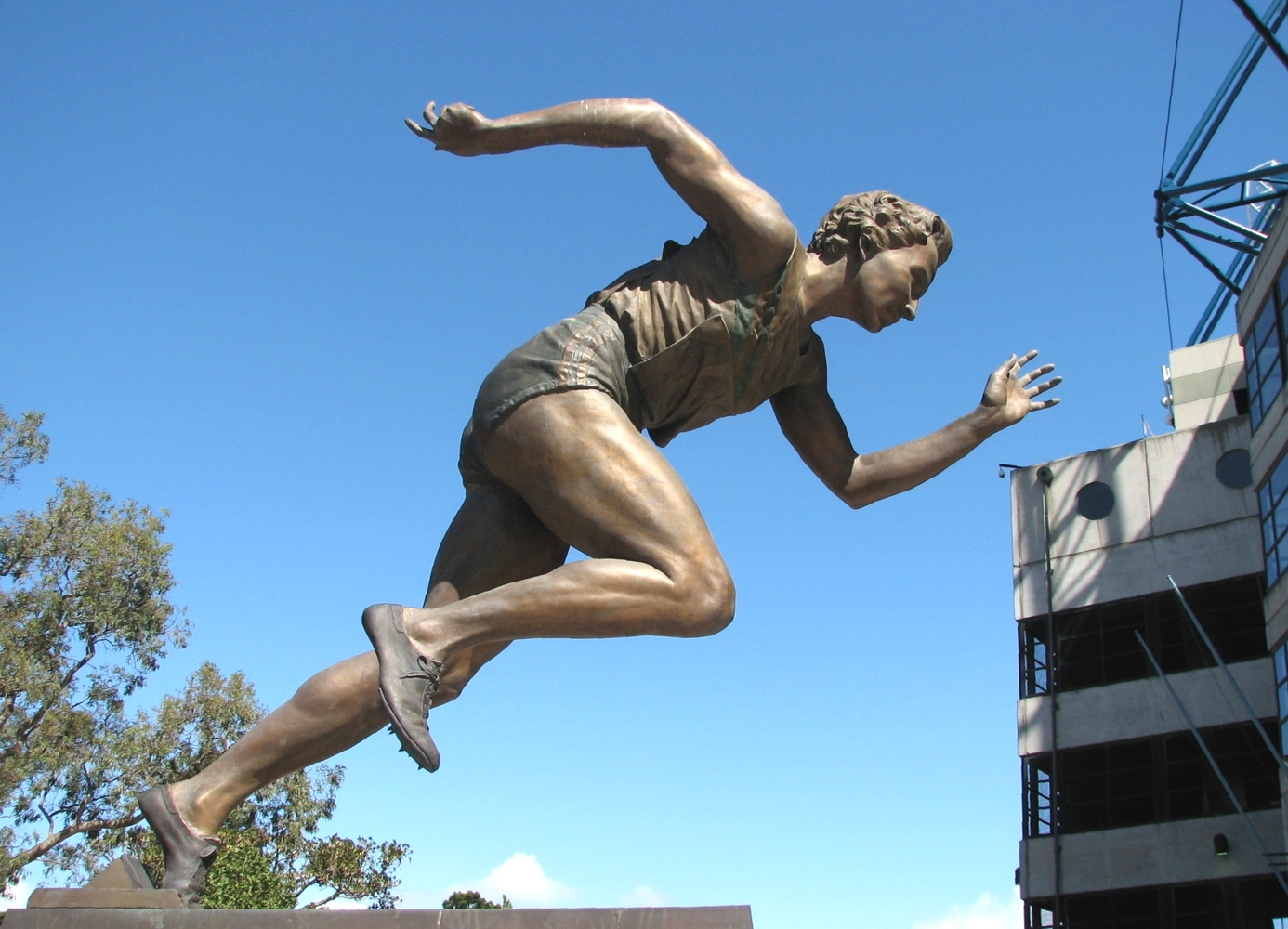
Statue of Shirley Strickland outside the Melbourne Cricket Ground. Sculptor: Louis Laumen, photo by Melburnian, Oct. 2006.