Wednesday, February 17, 2010
Just for fun: Large Hadron Rap
This isn't new, it was made over a year ago. However, now that the Large Hadron Collider is on and functioning, I thought it was worth a second look.


Tuesday, February 16, 2010
Viral biofilms
Some kinds of bacteria have been known to congregate into ‘biofilms’. Normally, free swimming bacteria which are susceptible to antibiotics and other treatments become remarkably resilient. They stick to surfaces with remarkable tenacity and are exceedingly difficult to kill. In addition, they sometimes produce toxins not made by their planktonic kin.
For the first time, researchers at the Institut Pasteur and CNRS have shown that the human T-lymphotropic virus type 1 (HTLV-1) retrovirus is capable of forming complex biofilm-like structures on the surface of infected cells.
The viral biofilms appear to serve the same function as their bacterial counterparts, namely to offer increased infectivity and protection from the immune system. Removing the viral biofilm from infected cell surfaces reduced infection rates by up to 80%.
Although it is not yet known whether other types of viruses can form these aggregates, scientists are hopeful that this new data will open up new anti-viral treatments that target biofilms.Monday, February 15, 2010
Finding stable super heavy elements

There have been 90 elements found in nature. Some two dozen more have been created in labs. Most of these are so transitory they exist barely long enough for researchers to take note of the fact that they were created. However, some scientists believe that there is an island of stability in super heavy elements yet to be found.

To test this hypothesis, scientists needed to accurately measure the atomic mass of a super heavy element. By determining the exact mass of the element, the binding energy can be calculated, which in turn tells how stable the element can be, and leads to predictions of even larger stable elements. Up to this point, binding energies had only been inferred from decay rates.
Nobelium (element 102) was chosen for this purpose and produced by firing calcium ions onto lead foil with a particle accelerator. Michael Block and his international colleagues used the SHIP (Separator for Heavy Ion reaction Products) filter to separate out the nobelium ions, which were then sent on through the ‘Shiptrap’ facility to trap the ions and measure their atomic mass.
This experiment yielded two firsts: the first time a super heavy element had been trapped, and the first time the atomic mass of a super heavy element had been measured with extreme accuracy (the error rate was estimated to be about 5 millionths of one percent).Predicted island of stability for super heavy elements, chart by Xanthine, 3/12/2006
Sunday, February 14, 2010
Walk like a charging elephant
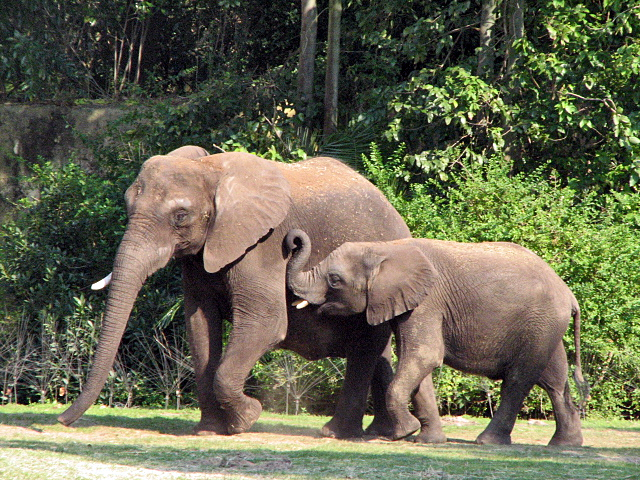
One of the things I love about science is the variety of questions it can answer. It’s really amazing how varied people’s interests are, and how creative they can be in finding answers. For example, Norman Heglund, from the Université Catholique de Louvain, Belgium, wondered whether charging elephants were truly running, or just speed walking.
Walking and running are actually two very different motions. Although both gaits convert potential energy stored in tendons and muscles into kinetic energy that moves the animal forward, the two movement patterns are quite dissimilar. Running animals use the stored energy to bounce forward like a pogo stick, whereas walking animals regain that stored energy by swinging their legs like a pendulum. Think of the bouncing, flexing backbone of a running dog, versus the more level backbone of the same dog when walking. Previous experiments by John Hutchinson of the Royal Veterinary College of London, indicated that elephants do not run at higher speeds but in fact simply walk faster.
Heglund wanted to test this hypothesis. Not having access to elephants in Belgium, he traveled to the Thai Elephant Conservation Centre in Lampang, Thailand, where he and his colleagues built a giant force-measuring platform. This eight meter long racetrack was made of one meter square force plates over a reinforced concrete foundation. Thirty-four elephants of assorted ages and weights were encouraged to cross the platform at speeds ranging from strolling to racing.
So, were the elephants running or walking when reaching top speeds? A little of both, it turns out. Although the elephants’ kinetic and potential energy plots resembled those of running animals, their centers of mass remained level during the first part of the stride, but bounced during the second part. It seemed as though the elephants were running with their front legs but walking with their hind legs.Despite this, the researchers found that elephants are highly efficient movers, using 1/3 the energy of most other animals. Elephants achieve this efficiency by having a high step frequency and maintaining at least two feet on the ground at all times, limiting the bouncing motion most animals experience at high speeds.
Saturday, February 13, 2010
Temperature-controlled capsules
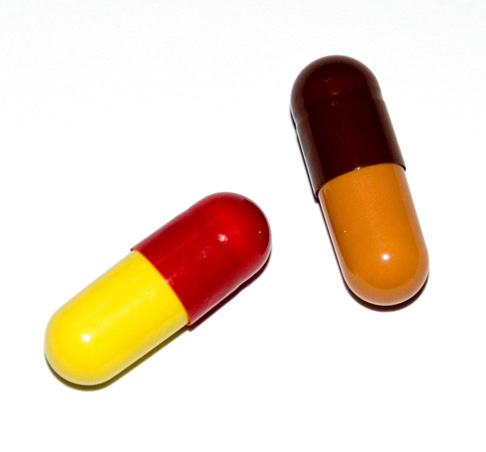
Mathieu Destribats, Véronique Schmitt and Rénal Backov of the Paul Pascal Research Center in Bordeaux have patented their design for smart capsules that release their contents at specific temperatures.
The current manner of manufacturing medicinal capsules is to place the therapeutic agent within a silica shell. This shell either has tiny pores through which the medicine can slowly escape, or the entire shell is designed to dissolve. However, neither process can be precisely controlled.
The researchers in this study have invented a novel capsule manufacturing process. Their capsules consist of the therapeutic agent mixed with oil with a specific melting temperature. When placed in water, the oil solidifies into droplets. These oil drops are then encapsulated in a silica shell. When the capsules are heated above the melting temperature of the oil, the oil expands, breaking open the silica shell and releasing the contents.
Oils can be carefully selected depending on how the agent is to be stored and/or used. Some typical melting points for oils and waxes:
- olive oil: –6 °C or 21 °F
- peanut oil: 3 °C or 37 °F
- coconut oil: 25 °C or 77 °F
- palm oil: 35 °C or 95 °F
- beeswax: 62-65 °C or 144-149 °F
- carnauba wax: 78-85 °C or 172-185 °F
Although this method would not work for time-released medicines (if the capsules released at all, this would happen instantly upon entering the body), it could prove useful for storing medicines. Alternatively, the capsules could be heated in a person’s hands before applying the contents to the skin. The authors also suggest that capsules containing bacteriocides could be placed in potential areas of contamination, such as air ducts, to release their contents when the spaces reached bacterial growth-friendly temperatures.
Friday, February 12, 2010
Public Science Opportunities
Home computers are becoming more and more common. They have tremendous processing power, but spend a large part of their time idly twiddling their bytes. In 1995, the Search for Extraterrestrial Intelligence (SETI) institute a team of astronomers from the University of Washington and UC Berkeley Space Science Lab* got the idea of harnessing that processing power. Starting in 1999, volunteers could allow SETI to ‘borrow’ their computers during idle moments to analyze chunks of data in the hopes of finding intelligent signals from space. This popular program, known as SETI@home, ran until 2005 when it was switched over to a new software platform called Berkeley Open Infrastructure for Network Computing (BOINC). The new and improved SETI@home still uses BOINC today.
Besides finding aliens, BOINC is being used for many other huge computational problems. For instance, MilkyWay@home, which was started in 2006 by Rensselaer Polytechnic Institute researchers, uses personal computers to map the Milky Way and neighboring galaxies. MilkyWay@home is currently the largest shared computer project, having surpassed SETI@home.
If you like the idea of doing your part for science but aren’t that interested in astronomy, BOINC has projects in mathematics, biology, chemistry, and other fields. And more are being started all the time. For example, the DNA@Home platform is being developed to find gene regulations sites on human DNA.
If you’re interested in signing up your computer for one of the BOINC projects, you can find the complete list here.*I attended a talk by Seth Shostak, executive director of SETI, on 2/14/2010, in which he informed me that SETI@home is not a SETI project, but is in fact a UC Berkeley program.

Screen shot of SETI@Home (Enhanced 5.27) BOINC Task, running under Microsoft Windows XP SP2
Thursday, February 11, 2010
Top 10 Autism Research Achievements

Autism Speaks, the largest autism advocacy group in the world, has issued their list of the ten most important achievements in autism research.
The list includes epidemiological studies on the number of affected individuals, genetic studies pinpointing genes that are associated with autism, and treatment regiments.
Briefly, here’s the list:
1. Epidemiological studies. Autism affects 1% of the population.
2. Early intervention. An early childhood intervention called the Early Start Denver Model has proven to be an effective therapy.
3. Genome wide association studies (comparing entire genomes between affected and unaffected people). So far, genes involved in neuronal connectivity have been implicated in autism.
4. Genome studies of copy number variants (CNV). Autism-associated CNV’s tend to turn up in genes associated with neural adherence and connection, and/or genes associated with the ubiquitin pathway (among other things, involved in the turnover of synaptic products).
5. Combined therapies. Using a mix of medical (such as risperidone, an anti-psychotic drug) and behavioral therapy has been tested.
6. Mouse studies. Mice without the gene neurexin-1alpha (involved in synaptic operation) display autism spectrum symptoms.
7. Mitochondrial dysfunction. Some patients with mitochondrial disorders are at increased risk for autistic regression, particularly after having a fever. (As an aside, the researchers looked for a connection with recent vaccination and did not find any correlation. This can be added to the long list of studies that have shown a complete lack of association between autism and vaccination.)
8. Late language development. Autistic children have been able to learn to speak starting as late as 12 years old.
9. Language regression. Loss of language skills is specific to autistic children.
10. Autoimmune diseases. A family history of type-1 diabetes or of rheumatoid arthritis in the mother were linked to autism in the offspring. The immune system of the mother during pregnancy may be implicated.
You can get more details, including scientific references here:
Subscribe to:
Posts (Atom)