Science-- there's something for everyone

Thursday, July 28, 2011

Dolphins have double sonar


It’s well known that dolphins use echolocation to navigate.  Recently, Josefin Starkhammer of Lund University and her colleagues from the National Marine Mammal Foundation in San Diego have discovered that dolphins are twice as capable as previously thought.  The researchers found that dolphins can generate two sound projections at once.

Echolocating dolphins emit high frequency sounds (ultrasounds) from organs within their foreheads.  These sound beams bounce of any objects (sea floor, predator, prey etc.) in their path and the resulting echo is interpreted by the animal’s brain. Although researchers knew that dolphins had two sound producing organs, it was assumed that only one was functional at a time.  Either both organs can function simultaneously, or some other process within the dolphins’ heads is dividing up single pulses.  In either case, more than one signal is leaving the dolphins’ heads.

Why send out two pulses?  As Starkhammer explains:
The beam projections have different frequencies and can be sent in different directions. The advantage is probably that the dolphin can locate the object more precisely.

Wednesday, July 27, 2011

Using bacteria to clean art


Cleaning valuable works of art is an extremely tricky process.  The restorer must remove dirt and salts without damaging the original paint or substrate.  Researchers from the Polytechnic University of Valencia, in conjunction with the restorers of the Sistine Chapel, have been using bacteria to help them clean murals.

The technique was first developed by University of Molise microbiologist Giancarlo Ranalli.  Briefly, the scientists apply a thin layer of gel containing the bacteria Pseudomonas to the artwork.  After about two hours, the gel is removed from the surface and any remaining bacteria are killed by the resulting dry environment.  During those few hours, the bacteria eat the white salt crusts that obscure the paintings.

Thus far, the technique has been successfully tested on two of the ceiling vaults in the heavily damaged Church of Santos Juanes (which had sustained both a devastating fire in 1936 and an improper restoration in the 1960’s).  The researchers plan to experiment with other strains of bacteria to remove other types of dirt or decomposition products.


Pilar Bosch of the Institute of Heritage Restoration working on the paintings in the Church of Santos Juanes in Valencia.
Credit: Image courtesy of Asociación RUVID.

Tuesday, July 26, 2011

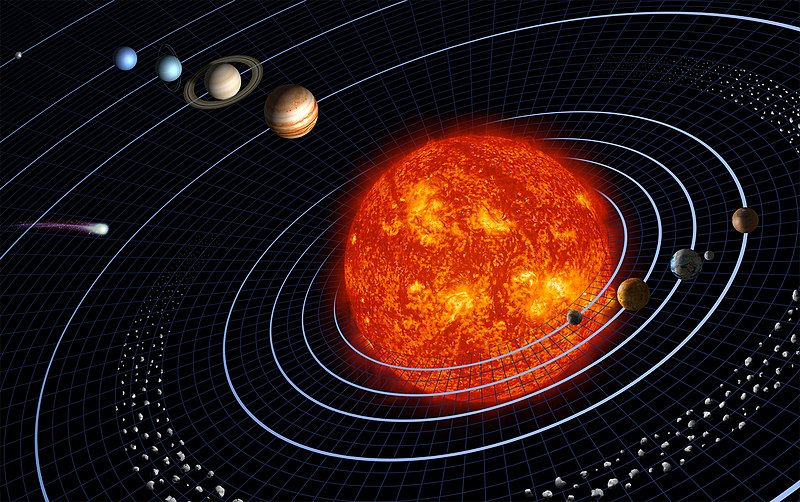
Jupiter’s Grand Tack Scenario

File:Solar sys.jpg
Planetary scientists have long wondered why Mars is so much smaller than the Earth or Venus.  An international team of astronomers led by Kevin Walsh of Southwest Research Institute may have discovered the answer.  Mars may have been robbed of building material by the wanderings of an early Jupiter.

As planets form around a star, they sweep together all the dust and rocks at their radius from that star.  The debris at that distance is gradually incorporated into that planet. Because Mars has a larger orbit than the Earth, it should have had that much more material in its path and consequently, it should have been larger than the Earth. In actuality, Mars is only a little over half as big as the Earth.


According to this new theory, early in the formation of the solar system, currents of gas pulled Jupiter inward from its birth position at 3.5 AU (astronomical units, one of which equals the distance from the Earth to the sun) to about 1.5 AU from the sun, exactly where Mars would eventually sit.  As Jupiter rolled through that region, it gathered much of the available debris to itself, depriving the early Mars of planet-building material and stunting its growth.  The interesting thing is that Jupiter then made an about face, probably because of Saturn’s pull, and moved back out to its current position at 5.2 AU.  This pattern of movement has been dubbed the ‘Grand Tack Scenario’.  As Walsh explains:
This change in direction is like the course that a sailboat takes when it tacks around a buoy.
New evidence from exoplanet research shows that gas giants do migrate inward and back out from their stars, so the Grand Tack Scenario is more likely than it sounds at first glance.  In fact, it may explain the distribution of asteroids throughout the solar system.  

Monday, July 25, 2011

Visualizing rods and cones


Rods and cones are light sensing cells that allow us to see.  Now thanks to innovations led by Alfredo Dubra of the University of Rochester, we can see the rods and cones. 


Caption: The image on the left shows the smallest cones at the center of the retina, (the fovea). Whenever we direct our gaze at something, for example to read, the image of what we are looking at is formed over these very important cones. The image on the right shows a more eccentric retinal location, in which the large bright dots with a dark ring around them are cones, and the surrounding (and far more abundant) smaller spots are rods.
Credit: University of Rochester/Biomedical Optics Express

The researchers used ‘adaptive optics’ a tool developed by astronomers to make distortion free images of stars.  In astronomy, a bright point, either a nearby star or focused laser, is used as a reference.  The adaptive optic system then uses a deformable mirror to compensate for atmospheric distortions, effectively eliminating the twinkling effect of stars.  This substantially increases a telescope’s resolution.  In the same way, using mirrors to compensate for the distortion created as light passes through the front of the eye increases the resolution of the ophthalmoscope to the point where individual rod cells can be discerned.

Dubra and his colleagues successfully collected images of rods and cones from the retinas of nine healthy people. You can see his explanation below:


It’s not hard to come up with medical uses for this new imaging ability.  Not only could the effects of eye diseases be seen in real time, so could the effects of drugs or other treatments.


Sunday, July 24, 2011

Adding injury to insult, wrinkle edition


Not only are wrinkles an unpleasant sign of aging, but they may also be a sign of bone loss.  According to a paper presented at the 2011 Endocrine Society Meeting by Lubna Pal of Yale University, increased wrinkling was associated with decreased bone mineral density.

Pal and her colleagues used participants who were already enrolled in the Kronos Early Estrogen Prevention Study (KEEPS), an ongoing study on the relationship between menopausal hormone therapy and heart disease.  The 114 subjects of Pal’s study had all had their last period within the past three years, and none had used either hormone replacement therapy or cosmetic surgery.  Both the depth and number of wrinkles in eleven locations across the face and neck, and the skin rigidity on forehead and cheeks were assessed for all 114 volunteers.  In addition, the women were tested for skeletal mass and density. Skin rigidity correlated positively with bone density, but wrinkles did not.

As Pal states:
The worse the wrinkles, the lesser the bone density, and this relationship was independent of age or of factors known to influence bone mass.

Although it’s a bit depressing to think that our wrinkles are indicating aging inside as well as outside, there is a silver (gray?) lining.  If these results are confirmed in larger studies, it could give doctors a quick way to assess which women should be monitored more closely for osteoporosis.

Saturday, July 23, 2011

Just for fun: More illusions

Like visual illusions? Have I got the youtube channel for you. Brusspup has a whole series of illusions like the one below.


Friday, July 22, 2011

Animals cooperate


Two more animals have been added to the annals of animal cooperation: elephants and African grey parrots.

The classical cooperation study used in chimpanzees and young children requires two individuals to perform a task. The two animals each must pull on a rope to bring a cart laden with treats within reach. If only one animal pulls, it will simply draw the rope completely out from around the cart.

The elephant study was conducted by Frans de Waal and his colleagues from Emory University and from the Forest Industry Organization in Lampang, Thailand. You can see some experiments below. Elephants were able to understand that that they must wait for a partner before pulling on their own rope.


The parrot study, led by Dalila Bovet of Paris West University Nanterre La DƩfense, showed similar results. However, African grey parrots were also able to divvy up two different types of tasks in order to get a reward. For example, one parrot might have to release a tray that the second parrot could then pull closer.

Interestingly, the personalities of the parrots seemed to come into play more than those of the elephants. When given a choice between a small reward that could be earned alone and a larger reward that required cooperation to obtain, two parrots (Zoe and Leo) worked well together but a third (Shango) always chose to work alone. Of course, it’s possible that the elephants in the Thailand study were willing to work together in different combinations because they were all part of the same family group. Like them, Zoe and Leo had been reared together, but Shango had been introduced later.