Science-- there's something for everyone

Tuesday, November 8, 2011

Therapeutic hypothermia for a heart attack


Yesterday, I wrote about warming, now a story about cooling.  Patients who underwent therapeutic cooling following a heart attack fared better than controls, according to a study by doctors at the Mayo Clinic.  Over two and half times as many hypothermia-treated patients survived their cardiac arrest as patients who had not been drastically cooled.

Therapeutic cooling is the process of lowering the body temperature to a point where metabolism is slowed down.  This can be done by applying cold packs externally or by IV fluids. The target body temperature of this process is 32–34 °C (90–93 °F).   The hope is that such treatment can prevent the brain damage that often results from lack of blood flow following cardiac arrest.  However, doctors were concerned that the extreme cooling could delay post-heart attack awakening, a critical component of continued diagnosis and treatment.  This did not turn out to be a problem.  Of the 227 patients in the study (128 treated with hypothermia and 99 controls), all awakened within the same time frame, and the cooled patients had a significantly higher survival rate.

Sudden cardiac arrest is the leading cause of death in U.S.  With current treatments, only 7% of victims survive.  Perhaps if patients can be immediately cooled down, that percentage might go up.

Monday, November 7, 2011

Global warming is real

In case you needed any more evidence, here are two more studies showing exactly that.  The first study, the Berkelely Earth Surface Temperature Study, is a review of the data from 15 sources compiled from almost 40,000 different surface temperature stations around the Earth.  This study, run by Berkeley physicist and former global warming skeptic Richard Muller, confirms that the Earth is getting warmer.  Muller himself was surprised at how closely the new data matched that of the previous studies.


Comparison of data showing decadal land-surface average world temperature changes from 15 different sources, some going back as far as 1800.

In case you aren’t familiar with the acronyms:
NASA GISS—NASA Goddard institute for Space Studies
NOAA—National Oceanic and Atmospheric Administration
HadCRU—Hadley center Climate Research Unit (the group that had been accused of scientific malfeasance by global warming deniers, but was later cleared of all wrongdoing).

Credit: Image courtesy of Berkeley Earth Surface Temperature.

The Berkeley study only went back a couple of centuries.  The next study, by Svante Björck of Lund University, goes back 20,000 years.  By examining ice cores from both the Northern and Southern hemispheres, he was able to show that the warming going on today is unlike previous warming events in Earth’s history.  On previous occasions, only one hemisphere warmed at a time, not both as is happening now.  This is evidence that the climate change we see is caused by an external force, namely us.

Sunday, November 6, 2011

Getting Grandpa’s kidney


As of last year, 93,000 people in the United States were on the waiting list for a donor kidney.  Needless to say, there aren’t enough to go around.  Now, new research by a team from Johns Hopkins may have broadened the search criteria.  The doctors, led by Dorry Segev, have found that older donors can safely donate kidneys even past the age of 70.

The researchers compared 219 kidney donors who were over the age of 70 at the time of their donation to a matched set of seniors who had not donated organs.  Not only did mortality not increase for the donors, but it actually decreased over the ten years after the donation.  This is not to suggest that donating a kidney can prolong your life.  Despite matching controls to donors as carefully as possible, the authors suggest that the criteria to become an older donor may have selected for slightly healthier individuals.  In other words, the donor group would probably have lived longer regardless of whether or not they gave a kidney.  In any case, they certainly weren’t handicapped by their choice to donate a kidney.

How did the recipients fare?  The kidneys from donors over age 70 did not last as long as kidneys from live donors under age 60.  However, the older kidneys were just as good as younger kidneys from deceased donors.  


In conclusion, if you need a kidney and Grandpa is willing to give you one of his, you should take it.  It’s a win-win for everyone.

Saturday, November 5, 2011

Just for Fun: Name the array


The National Radio Astronomy Observatory (NRAO) has been upgrading its Very Large Array (27 radio antennas outside of Socorro, New Mexico) with new electronics to replace the previously installed 70's era equipment.  To commemorate this change, the designation-challenged astronomers at NRAO are inviting the public to suggest a new name to match the array's new capabilities.


If you have a name in mind, especially one that's more imaginative than 'Hey, That's a Lot of Telescopes!' you can submit it here.  But don't delay! Entries will only be accepted until midnight on December 1st.   


Very Large Array, Socorro, New Mexico, taken by Hajor, 8/8/2004.


Hat tip:  Skeptics' Guide to the Universe.

Friday, November 4, 2011

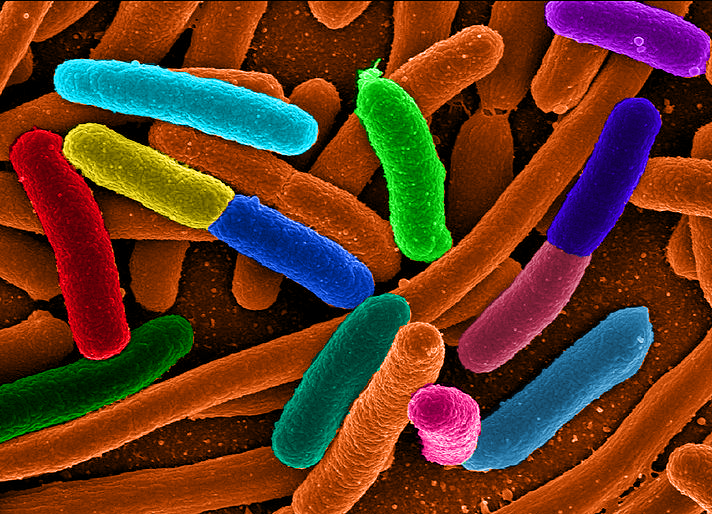
Do bacteria age?


Bacteria reproduce by simple fission, that is, they divide into two.  Until recently, those two daughter cells were thought to be identical.  However, a new study by University of California, San Diego researchers Camilla Rang, Annie Peng and Lin Chao calls that assumption into question.  According to their research, not only are the daughter cells not identical, but the differences between them allow bacteria to stay perpetually young.


False color image of E. coli.

Aging in multicellular organisms usually involves irreparable cell damage.  As our individual cells accumulate damage, this deterioration is eventually felt in our organs and entire bodies.  Single celled organisms also become corrupted over time.  It had been thought that an injured cell would distribute that damage evenly between its two daughters.  That turns out not to be the case.  Instead, each dividing cell preferentially gives one daughter most of the damage.  As this cycle goes on, a subset of the bacterial cells remain forever youthful and undamaged.

So the answer to whether bacteria age appears to be both yes and no.  Within a bacterial colony there are groups of cells that accumulate more and more damage, the very definition of aging.  But there are also cells that are constantly rejuvenated.

Thursday, November 3, 2011

More scarless surgery


I’ve written before about surgeons using natural orifices (usually the mouth or vagina) to perform surgical procedures on internal organs. Now Kofi Boahene and his colleagues from Johns Hopkins have used a scarless technique to access and remove tumors at the base of patients’ skulls.

Traditionally, expunging such tumors involves making incisions in the face and often removing bone.  Aside from the trauma of having disfiguring scars, the procedure can result in nerve damage and requires long recovery times.  Instead, the Johns Hopkins doctors used a different route to get to the tumor.  They used what Boahene describes as a ‘window…above the jawbone and below the cheekbone’.

After feeling around in my mouth for a bit, I can’t say that I can locate such a window.  I’ve therefore included the illustration below, which shows a ready-made access point behind the lower teeth.  By going through this window inside the mouth, the doctors decreased the surgical time required to remove a tumor by two thirds, and the recovery time to only one day.  And of course, there are no visible scars.


Illustration by Patrick J. Lynch, 12/23/2006.

This kind of surgery won’t work for everyone, but it may be an excellent choice for many patients who have tumors at the back of their heads or necks.

Wednesday, November 2, 2011

Junk DNA separates human from chimp


Researchers from the Georgia Institute of Technology have found that large DNA insertions near but not within genes may account for the evolutionary differences between humans and chimpanzees.   This may answer the question of how the two species can be so dissimilar, despite having genes that are over 98% identical. 

While it is true that the coding regions (parts of the genome that code for amino acids) of chimps and humans are virtually identical, the regions around those genes are much less similar. You may know these locations outside genes as 'junk DNA'.  However, not all junk is created equal, and some of these sequences do have a function.  


For example, self-replicating genetic fragments called transposable elements have inserted themselves into the non-coding regions of both humans and chimps, sometimes in tens of thousands of copies. Although these insertions don’t alter the genes themselves, they can affect gene expression.  In other words, they can affect how many copies of a protein are made from a particular gene.  To give a couple of overly simplified examples, suppose that one protein is involved in intelligence, and another in production of body hair.  Chimps and people may have identical genes encoding those proteins, but they don’t make the same amounts of them.

As expected, the scientists found that variation between chimps and humans caused by large insertions in non-coding regions did affect gene expression.  This means, of course, that regulatory sequences may be as important as genes in driving evolution.


Illustration by Kayla Orlinsky, 10/27/2011.