Science-- there's something for everyone

Thursday, January 10, 2013

A case of second impact syndrome


If you regularly read this blog, you know that concussions (aka mild traumatic brain injuries) are the result of the brain slamming against the inside of the skull. This can be caused either by rapid deceleration of the entire body or by direct impact to the head. Either way, the brain has a bruise that must heal. If an individual receives a second injury before the first has completely healed, this can result in ‘second impact syndrome’ (SIS), a devastating and often fatal neurological condition.

Doctors at the Indiana University School of Medicine, led by Elizabeth Weinstein, document the unfortunate case of a seventeen-year-old high school football player with SIS. This is the first time that doctors have brain CT scans both before and after the second injury.

After the first concussion, caused by a helmet-to-helmet crash during a game, the patient noticed immediate symptoms (dizziness, headache). A CT scan performed four days later was normal, as was the assessment of the boy’s mental and physical condition. 

The next day (day five after the initial injury), the patient returned to football training. After participating in ‘hitting drills' he collapsed, eventually falling into a coma. At the emergency room, a second CT showed extensive brain damage. That was three years ago, and the patient has regained only limited verbal, motor or cognitive skills.

It can be difficult enough to diagnose concussion, let alone figure out when a patient is sufficiently recovered to resume contact activities. Ordinarily, a normal CT scan can clear a player to return to practice. According to this case study, that’s not a sufficient test. This new data is not going to make the task of coaches and sports doctors any easier. 

Image by Patrick J. Lynch, medical illustrator, 2/2/2008.


Weinstein, E., Turner, M., Kuzma, B., & Feuer, H. (2013). Second impact syndrome in football: new imaging and insights into a rare and devastating condition Journal of Neurosurgery: Pediatrics, 1-4 DOI: 10.3171/2012.11.PEDS12343.


Wednesday, January 9, 2013

Just for fun: Feathered art


You won't believe the fantastic art creations Chris Maynard has made out of feathers. Do yourself a favor and check out his website.  Here's a taste, called 'turkey feather'.


By the way, Maynard only uses feathers that were donated from private aviaries or zoos.

Tuesday, January 8, 2013

Surgical ultrasound


Ultrasound has been used both for imaging and for disrupting tissues (like fragmenting kidney stones). However, it delivers too broad a punch (generally over 2 mm wide and 10 mm deep) to be useful for delicate repair work. You wouldn’t want to target a small blood vessel with such an inaccurate tool. High-frequency ultrasound would be more precise but among other problems, it can generate excessive heat. Luckily, researchers from the University of Michigan, led by Hyoung Won Baac, may have come up with a solution. They designed a laser-generated focused ultrasound (LGFU) that can target an area only 75 microns across using pressure rather than heat.

First, what is ultrasound? Like ‘ultraviolet’, ultrasound is composed of waves (sound instead of light) with a frequency above that which humans can hear (about 20 khz). That’s it. Just inaudible sound waves. Also as with the light spectrum, different ultrasound frequencies have different properties. Most medical ultrasounds have frequencies of a few Mhz (100 times higher than a person can hear). Baac’s device can produce ultrasound with frequencies above 15 Mhz.

To create their high-frequency LGFU, the scientists used a carbon nanotube lens to convert the light energy of a laser to sound. The lens also amplified those sound waves to create a pressure front that was able to target and break up a kidney stone only a few microns across without generating excessive heat. Even more impressively, the researchers were able to use the LGFU to remove an individual cell from amongst its neighbors.

The scientists predict that doctors will one day perform pain-free surgeries with ultrasound scalpels so precise that they evade all nerve cells. But before then, the device has to be tested on animals or humans, which hasn’t happened yet.


Baac HW, Ok JG, Maxwell A, Lee KT, Chen YC, Hart AJ, Xu Z, Yoon E, & Guo LJ (2012). Carbon-nanotube optoacoustic lens for focused ultrasound generation and high-precision targeted therapy. Scientific reports, 2 PMID: 23251775.


Monday, January 7, 2013

Can broken teeth explain big cat extinction?


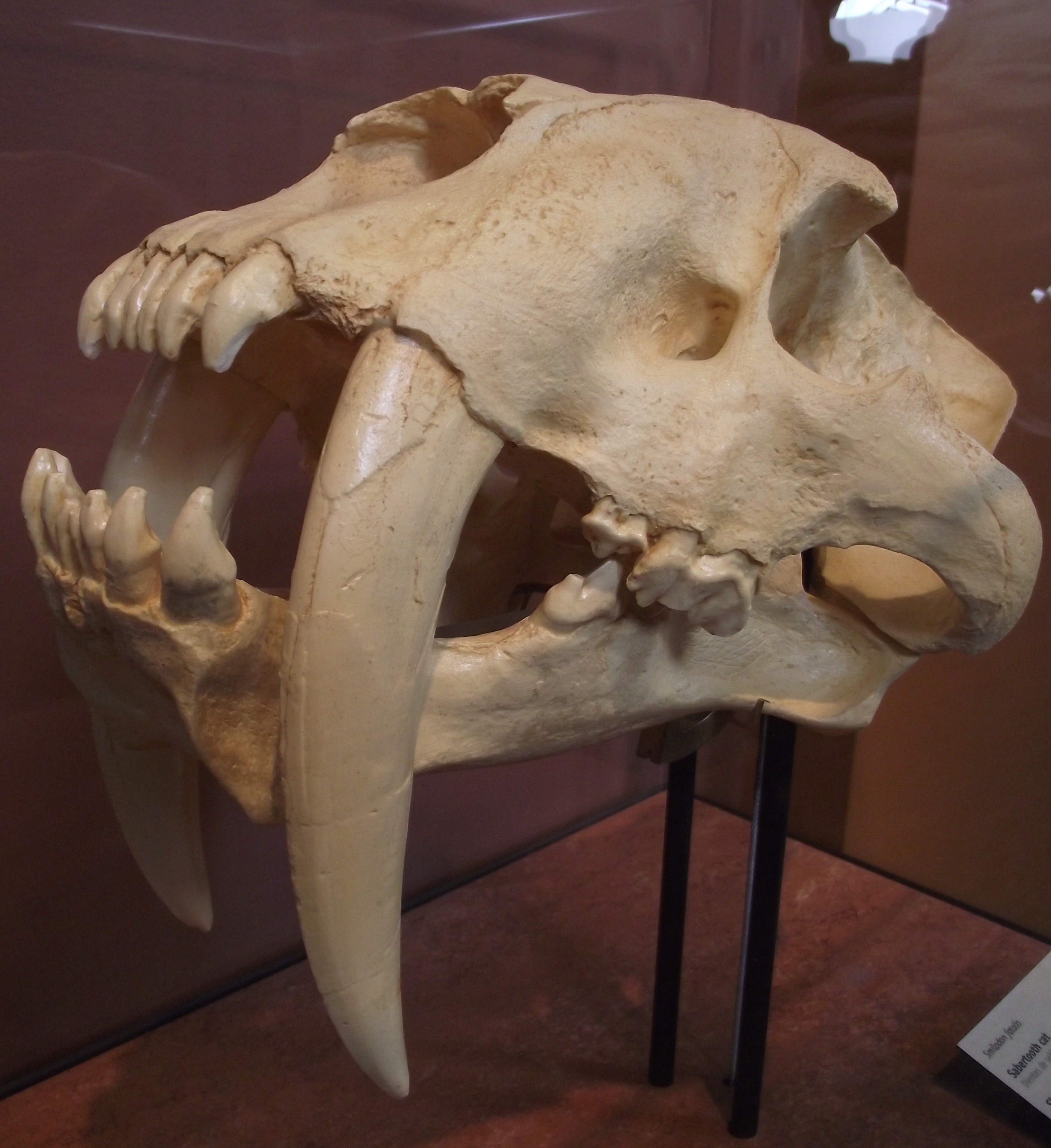
Why did American lions (Panthera atrox, top left) and saber-toothed cats (alluringly named Smilodon fatalis, bottom left) go extinct some 12,000 years ago? One hypothesis is that the predators fell on hard times as their prey was either culled by competing humans or decimated by climate change. The rational behind this idea is that the carnivores found at the La Brea tar pits (yes, I know how redundant this is) in California had a lot of broken teeth. About 7% of modern big cats and 9% of modern hyenas have broken teeth, whereas 36% of the extinct lion and 11% of saber-toothed cats had broken teeth. This led researchers to wonder if the large cats were forced to consume high amounts of bone as their prey diminished.

To be clear, the idea isn’t that the cats died out because they kept breaking their teeth while eating bones. Rather, the broken teeth are an indication that prey was scarce enough to discourage the predators from wasting any part of a carcass. It was the scarcity of prey that drove the carnivores to extinction.

So, is this idea correct? To find out, Larisa DeSantis from Vanderbilt University and her colleagues studied the fossilized teeth of the extinct cats. They used high-resolution scanning electron microscope (SEM) plus dental microwear texture analysis to determine whether the carnivores regularly consumed bones as well as flesh. The teeth of bone-avoiding carnivores (like cheetahs) have fewer pits and more long scratches than the teeth of animals that consume a lot of bone (like hyenas).

Both the American lion and the saber-toothed cat consumed less bone than all modern cats except for cheetahs. In addition, when the paleontologists compared the oldest specimens to the more recent ones (just before the species went extinct) they found that bone consumption had gone down, not up. The predators were not consuming more parts of their prey.

However these creatures were breaking their teeth, it wasn’t by eating bones. More significantly, this means that times were not lean enough to force the large cats to consume every part of their prey. So it’s back to the drawing board for both the cause of the tooth breakage and the extinctions.

American lion skull photo by By Claire H., 10/10/2008.


Larisa R. G. DeSantis, Blaine W. Schubert, Jessica R. Scott, & Peter S. Ungar (2012). Implications of Diet for the Extinction of Saber-Toothed Cats and American Lions PloS ONE, 7 (12) : doi:10.1371/journal.pone.0052453.


Friday, January 4, 2013

Dinosaurs really were gigantic


Non-avian dinosaurs (more commonly simply ‘dinosaurs’) are best known for being enormous. As a group, they include the largest land animals ever known. But were these gigantic specimens merely outliers? After all, among extant mammals, the largest ones (elephants, lions, horses, etc) are better known than shrews or voles, yet the majority of mammals are in fact rather small. Was this the case for dinosaurs as well, or did they truly have a unique pattern of size distribution?

To find out, Eoin O’Gorman and David Hone of University College London and Queen Mary University of London collected body mass information on five groups of living vertebrates: modern birds, reptiles, amphibians, fish and terrestrial mammals, and on three types of extinct animals: dinosaurs, pterosaurs and Cenozoic terrestrial mammals.

As you can see from the diagrams below, the distribution of dinosaur sizes (panel a) is significantly different from that of the other seven groups. There is far higher percentage of extremely large dinosaur species than there is of large species of any other vertebrate group. 

thumbnail

Frequency distribution of species body size for eight different animal groups: (a) extinct dinosaurs; (b) extant birds; (c) extant reptiles; (d) extant amphibians; (e) extant fish; (f) extant mammals; (g) extinct pterosaurs; and (h) Cenozoic mammals.
Silhouettes of the largest and smallest animal in each group are also shown (provided by Matt van Rooijen).

Gigantism gives an organism a number of advantages. They can conserve body heat in cold climates, have greater digestive efficiency and are less susceptible to predators. On the other hand, larger animals can overheat more easily and require far more food and space than small animals do. It’s not surprising that each vertebrate group comprises both large and small species, the bigger surprise is why dinosaurs don’t fall into the typical pattern.

The fact that extinct mammals and pterosaurs don’t have the same skewed size distribution as dinosaurs indicates that it’s not simply that prehistoric times favored larger animals. It’s also not that the largest modern animals have been hunted to extinction. In either of these cases, all the extinct animals would show the same pattern. And in fact, it isn’t even all dinosaurs that exhibit this trend. When the authors subdivided dinosaurs into three groups, Ornithischia, Sauropodomorpha and Theropoda, only the first two were skewed to contain mostly large specimens. Theropoda species fell into a bell-shaped distribution with most species being middle-sized.

I’ve discussed one possible reason for this unique size distribution before, namely that a single species of dinosaur can cover many different niches in the environment as it grows. You may not have sufficient habitat to support both small and large species if the offspring of the large species already fill all the niches. Of course, this same adaptation may have ultimately led to the dinosaurs’ demise.


Eoin J. O’Gorman, & David W. E. Hone (2012). Body Size Distribution of the Dinosaurs PloS ONE 7(12): e51925. doi:10.1371/journal.pone.0051925.


Thursday, January 3, 2013

Reinterpreting hominin climbing abilities


It can be dangerous to infer too much about function from the physical traces left by extinct animals. Case in point: the amount of time early hominins spent in trees. Australopithecus afarensis (creatures that lived over three million years ago typified by the specimen known as ‘Lucy’) had the foot and ankle structure required to walk upright. They also lacked the grasping feet possessed by our earlier ancestors and by modern chimpanzees. Can we therefore assume that Lucy and her ilk were poor tree climbers? Not so fast, say Vivek Venkataraman, Thomas Kraft, and Nathaniel Dominy from Dartmouth College. Just look at modern humans who routinely climb trees today.

The main reason modern hunter-gatherers climb trees is to acquire honey. In some communities, during ‘honey season’ men will spend a third of their total foraging time collecting honey. Needless to say, this activity requires much time in trees. Although some people make use of technology (pegs, harnesses, ropes), there are groups of people who climb trees without using any external aids.

The authors compared the agriculturalist Bakiga people with the hunter-gatherer Twa people, all living near Uganda's Bwindi Impenetrable National Park (a place that sounds like it should be featured in The Princess Bride). Twa men routinely climb trees unassisted, whereas Bakiga men rarely climb trees at all.

When chimpanzees climb a tree, they often use the method of grasping the trunk with their hands, planting their feet flat on the bark and ‘walking’ upward. Such ‘vertical climbing’ requires a high degree of ankle flexation that didn’t seem to be permitted by modern human anatomy. It turns out that Twa men are able to flex their ankles to nearly the same degree as chimpanzees and have been documented walking up trees in the same manner. In addition, Twa men had much longer leg muscle fibers than Bakiga men. The combination of longer muscle fibers plus flexible ankles make the Twa extremely accomplished tree climbers despite having modern human anatomy.

Clearly, if modern humans can be expert climbers, so could early hominins like Lucy. This certainly doesn’t prove that A. afarensis spent their days in trees, but it does mean that they could have.


Venkataraman, V., Kraft, T., & Dominy, N. (2012). Tree climbing and human evolution Proceedings of the National Academy of Sciences DOI: 10.1073/pnas.1208717110.


Wednesday, January 2, 2013

Just for fun: Weirdest stories of 2012


National Geographic compiled a list of the ten weirdest nature stories of 2012. Check out their Weird & Wild files to see them all, but here's my favorite:

The maned lioness. 
Yes, this is a female lion. These extremely rare specimens probably received an overabundance of androgens in the womb. You can read the story here.


A maned lioness in Botswana's Okavango Delta. 
Photograph courtesy Deon De Villiers.