Science-- there's something for everyone

Tuesday, April 2, 2013

It's the second ever quasar triplet!


An international team of astronomers, led by Emanuele Farina of the University of Insubria in Como, has discovered a triplet of quasars. At this point, you might be thinking, ‘this would be a whole lot more exciting if I knew what a quasar was’. Or maybe that’s just me. In any case, writing this article gave me a great excuse to learn more about quasars.
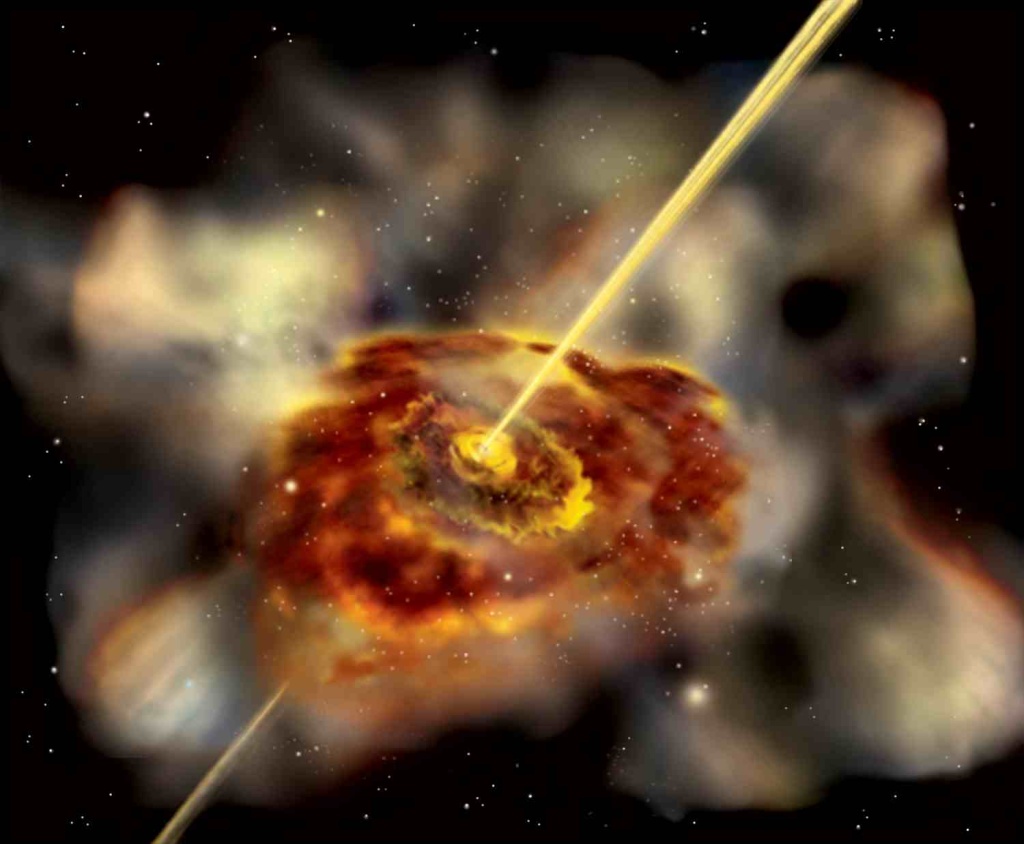

To begin with, ‘quasar’ is actually short for ‘quasi-stellar radio source’. That is, it's a source of electromagnetic energy that’s emanating from a star-like point.  In fact, a quasar is no kind of star but a supermassive black hole surrounded by an accretion disk. For this reason, cosmologists now call them quasi-stellar objects (QSOs), so I’ll switch to that terminology. As material falls toward that black hole, massive collisions occur that form the accretion disc circling the black hole and emit energy.

Actually, that understates the case quite a lot. QSOs are among the brightest objects in the entire universe, each one putting out many times the energy of an entire galaxy. This is why we can see them at all, since they are also among the farthest objects, each at least three billion light years away. QSOs are found at the center of some young galaxies. In fact, we often only know about that galaxy’s existence because we see the QSO in its center. Galaxies in which a supermassive black hole is actively munching on the stars around it at a great enough rate to produce a QSO, are called ‘active galaxies’.

To make things even more interesting, all the energy from a QSO is usually projected along a single line rather than equally in all directions. You can see an artist’s rendition of this above.

So, at the center of a galaxy, you have a supermassive black hole (with a mass of about a billion of our suns) that’s generating enough energy to become an incredibly bright QSO. Under rare circumstances, possibly due to the collision of two such galaxies, you end up with a binary system of QSOs. Imagine how often three such galaxies combine. To give you an idea, this is only the second triplet group of QSOs ever found (the previous one was discovered over six years ago). Because of the placement of the three QSOs, the authors suggest that two of them (B and C) interacted with each other first before the third one (A) joined the grouping.


An infrared image of the triple quasar system QQQ J1519+0627, made using the 3.5-m aperture telescope of the Calar Alto Observatory. The three quasars are labelled A, B and C.
Credit: Emanuele Paolo Farina.

I think you can now see why this news is so exciting. Click the reaction boxes below to let me know if you agree.

You can learn more about QSOs here, here and here.


Farina, E., Montuori, C., Decarli, R., & Fumagalli, M. (2013). Caught in the act: discovery of a physical quasar triplet Monthly Notices of the Royal Astronomical Society DOI: 10.1093/mnras/stt209.


Monday, April 1, 2013

Giant robotic jellyfish to roam the seas


No, this isn’t an April Fool’s prank. Engineers at the Virginia Tech College of Engineering are really at work developing a robot that mimics the swimming ability of jellyfish. You can see an 80 kg prototype, dubbed Cyro, being tested by Virginia Tech students below.


Why emulate a jellyfish? Jellyfish expend remarkably little energy for propulsion. A robot using similar methods of locomotion would be able to travel great distances without recharging. Thus, they could be sent on long reconnaissance or environmental monitoring missions. For example, the robots could be used to map the ocean floor or monitor water quality. Of course, they are being funded by the US Naval Undersea Warfare Center, so that probably does not rule out military or surveillance usage. But don’t worry, the researchers, led by Shashank Priya, are years away from having a fully functional model.

By the way, here’s the creature that inspired the engineers: Cyanea capillata, or lion’s mane jellyfish. It's the largest known jellyfish, with a bell over two meters across and tentacles that can reach 37 meters. The name ‘Cryo’ is a combination of ‘Cyanea’ and ‘robot’.

 Virginia Tech Engineers Create Cyro Robotic Jellyfish With Surveillance Capabilities
Credit: Dan Hershman

Notice the new reactions tool at the bottom? Tell me what you think!

Friday, March 29, 2013

Closing in on the origin of dog domestication


In 1975, the skull of an ancient canid (a member of the dog family) was discovered in Razboinichya cave within the Altai Republic, a mountainous region in southern Siberia. The skull was suspected to be that of a dog rather than a wolf or other canid. However, radiocarbon dating showed the skull to be about 33,000 years old, which is more than double the age of the oldest confirmed dog specimens. If the Altai skull was in fact a dog, that would significantly set back the date of dog domestication. The problem is that it's difficult to discriminate between early dog and wolf skulls. Researchers led by Anna Druzhkova of the Siberian Branch of the Russian Academy of Sciences solved that problem by doing mitochondrial DNA (mtDNA) analysis on the skull. They showed that it is indeed from a dog. This means that dogs have been around for a very long time, long before the invention of agriculture or the wheel.

thumbnail

The Razboinichya canid.
A)   aerial view, B) profile, C) palate, D) left mandible, E) left lower tooth row
(scale on ruler in cm). Sub-triangular hole in the skull is the place of initial sampling for 14C dating in 2007.

There is little doubt that dogs are the domesticated descendents of grey wolves. There is, however, a fair bit of controversy as to when those domestication events first occurred. We have archeological evidence of the existence of dogs (as a distinct species from wolves) at least 14,000 years ago, but they undoubtedly emerged much earlier. Without DNA analysis, it’s difficult to prove whether ancient specimens are really dogs rather than wolves. MtDNA, which is inherited only from the mother and hence has a less complicated provenance, has been particularly helpful in creating phylogenetic trees.

The scientists extracted mtDNA from the Altai skull and compared it to the mtDNA of 72 different dogs, 30 wolves, 4 coyotes and 35 prehistoric canids. Most importantly, three of the wolf specimens were from fragments of contemporaneous remains found within the same cave as the dog skull. If the Altai skull had belonged to a wolf, it should have most closely matched the other wolves living in the same area at the same time. This was not what the researchers found. Instead, the Altai skull mtDNA most closely matched the DNA of dogs and was not closely related to the wolves that coexisted with it. 

We still can’t say for sure when dogs first split off genetically from wolves. However, these data suggest that it happened more than 33,000 years ago, by which point they were already separate species. 

For some fascinating interviews about the origin of dog domestication, listen to this episode of Skeptically Speaking.


Druzhkova, A., Thalmann, O., Trifonov, V., Leonard, J., Vorobieva, N., Ovodov, N., Graphodatsky, A., & Wayne, R. (2013). Ancient DNA Analysis Affirms the Canid from Altai as a Primitive Dog PLoS ONE, 8 (3) DOI: 10.1371/journal.pone.0057754 

Ovodov, N., Crockford, S., Kuzmin, Y., Higham, T., Hodgins, G., & van der Plicht, J. (2011). A 33,000-Year-Old Incipient Dog from the Altai Mountains of Siberia: Evidence of the Earliest Domestication Disrupted by the Last Glacial Maximum PLoS ONE, 6 (7) DOI: 10.1371/journal.pone.0022821.

Thursday, March 28, 2013

To rant or not to rant


Who hasn’t occasionally felt like indulging in an online rant against an injustice or an example of stupidity? The good news is that there are myriad sites dedicated to just this activity. Whatever triggers your ire, there’s a website where you can pour out your vitriol to like-minded enraged compatriots. The bad news is that you may not be doing yourself a favor if you partake in this kind of venting.

Ryan Martin and his colleagues from the University of Wisconsin-Green Bay gave 91 college students a Differential Emotions Scale (DES) test to evaluate their levels of happiness, sadness, anger and/or fear on a scale of 0 to 100. Immediately after assessing their current emotions, they were asked to spend five minutes reading through the posts on a rant-site (screen shots were used so that all participants read the exact same rants). After reading the site, the subjects completed another DES. Next, the volunteers were asked to spend five minutes writing their own anonymous rant on any topic they chose. Upon completion, they filled out a final DES.

Reading the rants caused the average person’s happiness levels to decrease and sadness levels to increase. However, the difference wasn’t extreme. For both emotions, the post-reading levels were less than five points different. Remember, this was on a scale of 100 possible points. Writing their own rants affected participants more significantly. People’s happiness decreased by ten points and their anger increased by close to fourteen points after writing their screeds.

The subjects were each asked whether they’d like their own rant posted onto the site they had been reading (though none were actually posted regardless of preference). Those who wished to publish had experienced more anger while reading posts than those who did not want their own vents published. On the other hand, the people who were ready to publish their own rants had less decrease in happiness while writing those rants than people who didn’t want to publish. Interestingly, the subset of participants (7%) who said they would go back to the rant site on their own time actually experienced an increase in happiness while reading the site.

This data suggests that for most people, reading and writing rants is counterproductive. They were more angry and sad and less happy after engaging in these activities. However, for the people who looked forward to publishing their own rants, reading and writing rants seemed to be somewhat enjoyable. I should point out that this was a small, highly subjective study with no controls, and that the body of evidence about the value of catharsis is mixed. I think the bottom line is that if you find that reading diatribes makes you angry or anxious, it’s probably not the best activity for you. Personally, I’m very selective about reading the comments on YouTube channels or blogs (except mine, I love the comments on The Stochastic Scientist!). 


Martin, R., Coyier, K., VanSistine, L., & Schroeder, K. (2013). Anger on the Internet: The Perceived Value of Rant-Sites Cyberpsychology, Behavior, and Social Networking, 16 (2), 119-122 DOI: 10.1089/cyber.2012.0130.


Wednesday, March 27, 2013

Just for fun: Iron Egghead Video Contest


Scientific American sponsors the ‘Iron Egghead Video Contest’. The goal of this contest is to explain an aspect of human anatomy or a biological function using only the following props: paper (or other writing surface), writing implement, rubberbands, paper clips, string, cups, balls and yourself/yourselves in a two minute video. 

Below, the grand prize winners explain our adrenal glands in a way you won't forget.


You can see another entry here.


Tuesday, March 26, 2013

The temporal Doppler effect makes the future seem closer


We’ve all experienced the Doppler effect. This is what causes the change in sound we hear as a siren approaches and then passes us. The sound waves shift in frequency as each crest takes first shorter and shorter and then longer and longer to reach us. According to researchers led by Eugene Caruso of the University of Chicago, there is also a ‘temporal Doppler effect’ that makes events in the future seem closer to us than events in the past.

In one set of experiments, the scientists asked volunteers to think ahead a specific amount of time in the future (a week, a month or a year) and to think back the same amount of time in the past. The subjects reported that the future seemed closer than the past. You can try this yourself and see if you agree. We’re about equidistant from Christmas and the end of the school year right now. Which seems closer?

One possible reason for this observation is that we perceive time as moving, just like objects or sounds waves. We feel as if the past is actually receding and the future approaching. If so, our own physical movements might affect that perception. To test this, the researchers submersed undergraduates in a virtual reality environment in which they moved either forward or backward and then asked the students about their time perceptions. Participants felt that the future was closer than the past when they were moving forward but not when moving backward.

This is yet another example of how our brains fool us about the world around us. And of course, I can’t end a story about time without my favorite quotation, usually (but probably wrongly) attributed to Groucho Marx:

Time flies like an arrow,
Fruit flies like a banana.
Thank you, I'll be here all week.


Caruso, E., Van Boven, L., Chin, M., & Ward, A. (2013). The Temporal Doppler Effect: When the Future Feels Closer Than the Past Psychological Science DOI: 10.1177/0956797612458804.


Monday, March 25, 2013

How to get people to donate blood

If you want people to do something, is it better to tell them what wonderful things will happen if they do as you ask, or what terrible things will happen if they don’t? In other words, should you entice or threaten? That’s a question Eileen Chou from the University of Virginia and Keith Murnighan of Northwestern University set out to answer, at least with respect to blood donation.

There are chronic shortages in the supply of blood available for transfusions. Hopefully, the need for donated blood will someday be eliminated by the development of artificial blood. In the meantime, however, the Red Cross is working on getting more people to donate blood. To that end, they took a close look at the messaging used to encourage people to donate blood.

The authors sent 3500 undergraduates one of five different emails soliciting blood donations. One email merely stated the time and place at which the recipient could donate blood. The other four were framed as either saving lives (gains to be made if the subject accedes to the request) or preventing deaths (losses to be suffered if the person doesn’t comply). In addition, each version was presented either as being urgent or moderately important.

Here’s the urgent, loss prevention message:
Don’t delay. Help prevent someone from dying! Each year, 4.5 million Americans would die without blood transfusions. Every second, 2 people could die waiting for blood. Every pint that you donate can help them avoid dying. Don’t delay! Help prevent unnecessary deaths.
And the moderate need, gain message: 
Act now. Help save someone’s life! Every day, many people could be saved by donated blood. Every pint that you donate can help them stay healthy. Act now! Promote healthy lives.
I haven’t included the other two variations, but you get the idea. Which message would be more likely to drive you to the donation site? It turns out that the ‘prevent a death’ message was far more successful than the ‘save a life’ message. More than three times as many people showed up to donate blood after receiving the ‘loss’ message than did for the ‘gain’ message. Interestingly, the degree of need did not seem to matter very much. Perhaps, people already have a sense of how essential it is to donate blood.

This greater desire to prevent loss versus to achieve gain has been documented in other arenas. The authors of this study performed a second study in which they tested whether requests to prevent a charity from no longer being able to provide services would elicit more or fewer contributions than requests to increase that charity’s services. Again, people were more charitable to prevent losses.

I guess the lesson from this data is that if you want someone to do something, give them the doomsday scenario and not the possible utopia their actions could create.


Chou, E., & Murnighan, J. (2013). Life or Death Decisions: Framing the Call for Help PLoS ONE, 8 (3) DOI: 10.1371/journal.pone.0057351.