Science-- there's something for everyone

Thursday, April 11, 2013

Why is gastric bypass so effective?


Gastric bypass surgery is a highly effective treatment for obesity. It involves surgically sealing off or removing most of a person’s stomach and attaching the remaining small stomach pocket to the small intestine. Thus, a person is only able to eat a small amount before feeling full. You may think that this inability to eat large meals is the driving force behind the high success rate of gastric bypass. While that is important, it may not be the main factor. It may be more about the microbes.

Alice Liou of Massachusetts General Hospital and her colleagues used a mouse model of gastric bypass to compare the pre-and post-operative fauna in the digestive tracts of mice with diet-induced obesity. One group (GB) received gastric bypass surgery similar to that used in humans. The second (SHAM) also underwent surgery but that operation did not result in gastric bypass. All the mice were fed a liquid diet for two weeks and then were allowed to eat as much as they liked. 

Post surgery, the GB mice maintained normal weights while the SHAM mice quickly regained their obese statures. So, far this is no surprise. After all the SHAM mice had not had gastric bypass. However, there were significant differences in the composition of the gut microbes between GB mice and the SHAM mice. In other words, having real gastric bypass surgery affected the make-up of the mice’s intestinal flora. This was true regardless of whether the mice were fed a normal or a high fat diet.

Here’s the fascinating part: the scientists inoculated germ-free mice (mice with no gut bacteria of their own) with fecal samples from the GB or SHAM mice. In effect, the researchers were transplanting the intestinal environment of the GB or SHAM mice into the germ-line mice without surgery. The germ-free mice that received gut bacteria from the GB mice lost weight and fat tissue. This was without any diet restrictions. In contrast, mice receiving fecal matter from SHAM mice did not lose weight. This strongly suggests that it is the altered microbial environment of the gut rather than meal size restriction that drives gastric bypass weight loss.

This is actually a hopeful sign. It means that we might be able to achieve the same results as gastric bypass surgery by simply manipulating a person’s microbial content. The bad news is that we’re far from understanding how to do this safely. We don't know what it is about gastric bypass that causes the change in bacterial population and we don't know exactly which of those changes are critical for weight loss. Still, it's a start.


Liou, A., Paziuk, M., Luevano, J., Machineni, S., Turnbaugh, P., & Kaplan, L. (2013). Conserved Shifts in the Gut Microbiota Due to Gastric Bypass Reduce Host Weight and Adiposity Science Translational Medicine, 5 (178), 178-178 DOI: 10.1126/scitranslmed.3005687.


Wednesday, April 10, 2013

Just for fun: Ball's eye view


If you're a fan of American football, you've undoubtedly seen the game from every angle. Except one, that is. Thanks to the work of Kris Kitani and others from Carnegie Mellon University and the University of Electro-Communications, Tokyo, we now have the football's view of the game. 

The researchers added a camera to a football, but more importantly, created an algorithm to translate the raw blur of motion (left) into something watchable (right):


The researchers don't expect to see this ball (shown below) used in standard play.


Image courtesy of Carnegie Mellon University.


Tuesday, April 9, 2013

Does size matter? Yes, I'm talking about what you think I'm talking about


I’m not sure what’s more amusing, that people are studying how penis size affects male attractiveness or that the authors of the study are all men. Brian Mautz and Michael Jennions of Australian National University, Bob Wong from Monash University and Richard Peters of La Trobe University addressed the question of whether sexual selection could have played a role in the evolution of male genitalia. See, this is a serious study.

The authors presented 105 heterosexual women with life-sized computer-generated images of naked men. While there are obviously men who could also weigh in on penis preference, those relationships are irrelevant from an evolutionary standpoint. Enough said about that. The images varied in three ways: height, body shape and flaccid penis size, each with seven possible dimensions; thus, there were a total of 343 different images (there are examples in the paper, which I’m not going to reproduce here). The women were each shown a random subset of 53 of the images and asked to rank them for ‘attractiveness as sexual partners’.

The most important trait of the three being tested was body shape. Specifically, women liked to see the right shoulder to hip ratio in their potential paramours. In fact, nearly 80% of the variation in attractiveness could be accounted for by this one characteristic. Height and penis size did add a bit to the equation, but only about 6% and 5% respectively. Not surprisingly, taller women considered height to be more important than shorter women did.

So, does size matter? If we go back in history to a time before clothing, women could have used penis size to evaluate mates. However, if they were anything like modern women, male genitalia was not their top priority in choosing a partner. Besides, in this study, the meager advantage was in favor of penises that were considerably larger than normal (sorry, guys). This suggests that women’s inclinations probably did not greatly influence the current range of male equipment. Glad we got that cleared up.

UPDATE 4/10/13: Greg Laden has some interesting points about why the whole premise of paleolithic women being able to evaluate and select mates based on penis size is flawed at his blog.


Mautz, B., Wong, B., Peters, R., & Jennions, M. (2013). Penis size interacts with body shape and height to influence male attractiveness Proceedings of the National Academy of Sciences DOI: 10.1073/pnas.1219361110.


Monday, April 8, 2013

How to pick from seven sexes


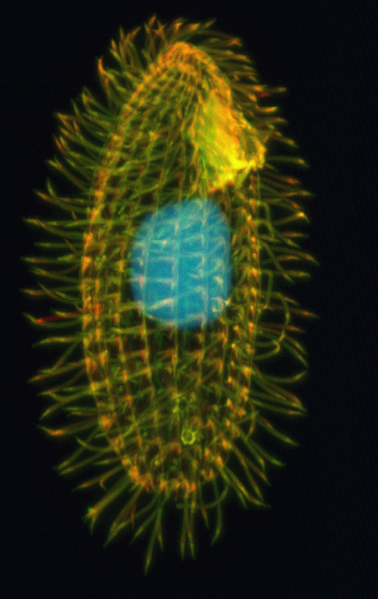
File:Tetrahymena thermophila.png
Meet Tetrahymena thermophila, a one-celled eukaryote with seven different sexes (aka mating types). A cell of one mating type can successfully mate with a cell from any of the other six mating types. And that’s not even the most interesting part of this tiny creature’s sex life. It turns out that the mating types are assigned stochastically. According to first author Marcella Cervantes of the University of California, Santa Barbara and her colleagues, each cell’s mating type is effectively determined by random chance rather than by genetic history.

Our story begins with the observation that T. thermophila have two nuclei rather than one. One nucleus contains the ‘somatic’ genome, which is responsible for the everyday running of the cell. The other, smaller nucleus contains the inactive ‘germline’ genome. We keep our germline genomes in our ovaries and testes. Within the germline genome are all seven pairs of sex determination genes, one for each of the possible mating types. The somatic genome contains only a single set of mating type genes, and it is this set that determines what that cell’s sex will be.

This means that while each T. thermophila cell contains all the genetic material necessary to become any mating type, six of those genes are only found in the quiescent germline genome. Only one set of mating type genes finds its way into the actively expressed somatic genome. Here’s how that happens.

When two T. thermophila mate, they exchange genetic material with each other (unlike with our unions, no third individual is created). Both cells subsequently destroy their own somatic genomes. They then use material from their germline genomes to construct new somatic genomes. But remember, the germline genome includes genes for all seven sexes. During the process of rebuilding the somatic genome, six of those mating types genes are excised so that only a single one remains. There is an equal probability that any one of the seven sets of mating type genes could be the last one standing.

This means that the sex of the cell after a conjugation event is in no way related to the sex of that same cell before that event. Meanwhile, the ‘reborn’ cell retains all the mating type genes within its own germline genome so that it can continue the tradition.

You might be wondering why an organism would need seven different sexes. Note that T. thermophila only mate under conditions of extreme duress. When you're in danger of starving to death, it’s best not to waste too much time looking for a suitable mate, especially when you’re only 40 or so microns long and can only travel so far. If you can successfully mate with six out of every seven potential partners you meet, so much the better.


Image top left: Tetrahymena thermophila 
Credit: Robinson, R. (2006). Ciliate Genome Sequence Reveals Unique Features of a Model Eukaryote PLoS Biology, 4 (9) DOI: 10.1371/journal.pbio.0040304

Article: Cervantes, M., Hamilton, E., Xiong, J., Lawson, M., Yuan, D., Hadjithomas, M., Miao, W., & Orias, E. (2013). Selecting One of Several Mating Types through Gene Segment Joining and Deletion in Tetrahymena thermophila PLoS Biology, 11 (3) DOI: 10.1371/journal.pbio.1001518.


Friday, April 5, 2013

Robots for off the beaten path

It's hard enough for humans to slog through soft sand, how well could a robot possibly handle that kind of terrain? Pretty well, if it's the prototype designed by Chen Li of UC Berkeley and Tingnan Zhang and Daniel Goldman of Georgia Tech. You can see one of their designs below:


You won't be surprised to learn that the scientists used lizards and insects for inspiration in building their robot. In particular, they were interested in how animals make multifunctional usage of their limbs to cope with different situations. To that end, they made their robots struggle through sand, glass spheres, and even poppy seeds.

The authors expect their research to pay off in building better robots for both exploring other planets and for search and rescue missions here on Earth. However, those are just two of the myriad uses for a robot that doesn't require solid ground for movement.


You can see Goldman explain the results below. Yet another use for 3D printing!


Li, C., Zhang, T., & Goldman, D. (2013). A Terradynamics of Legged Locomotion on Granular Media Science, 339 (6126), 1408-1412 DOI: 10.1126/science.1229163.


Thursday, April 4, 2013

Waking up during surgery is a rare event


One of the worst nightmares for anyone contemplating surgery is of waking up during the operation. Unfortunately, this does happen, albeit extremely rarely. Anesthetists make every effort to ensure that people do not wake up when they’re not supposed to, and that includes collecting data on the events. To that end, anesthetists from the UK and Ireland have conducted a huge survey on accidental awareness during general anesthesia.

They found a few interesting things, many of them reassuring. Between the over 7000 anesthetists surveyed, there were only 153 cases of accidental awareness, or one in about 15,000 surgeries. This is considerably lower than the previous reports of one per thousand. This discrepancy could be because complaints about waking up in surgery were not passed on to the anesthetists, who typically do not interact with patients after surgery. More hopefully, the rates have really decreased significantly.

Of these accidental awakenings, nearly half were caught before the surgery actually started. There were only 46 cases of patients waking up on the operating table, or about one in 50,000. 

In the not at all surprising category: people who woke up during surgery experienced more pain and distress than people who woke up before or too soon after the surgery.

What can be done to cut down the incidents of accidental awareness during surgery even more? Two words: training and monitoring. Although two thirds of the UK medical centers in the survey provided depth of anesthesia monitors, less than 2% of anesthetists routinely use them. Only 4.5% of the centers have any kind of policy for preventing or managing awareness during surgery.

By the way, waking up during surgery was not considered the worst surgical complication for either patients or doctors. For patients, nausea and vomiting took first place. For anesthetists, it was death. I’m glad to see that the anesthetists have their priorities right.


Pandit, J., Cook, T., Jonker, W., O'Sullivan, E., & , . (2013). A national survey of anaesthetists (NAP5 Baseline) to estimate an annual incidence of accidental awareness during general anaesthesia in the UK Anaesthesia, 68 (4), 343-353 DOI: 10.1111/anae.12190.


Wednesday, April 3, 2013

Just for fun: Solar Roadways

I'm a huge proponent of solar power. We just got solar panels installed on our home, and so far, we love them. So you can imagine how excited I was to hear about the possibility of building solar roadways. The safety possibilities with LEDs and sensors are particularly intriguing.


You can read more about solar roads and about Wireless Advanced Vehicle Electrification (WAVE) at Co-Exist.