Science-- there's something for everyone

Thursday, June 27, 2013

A mother’s gastric bypass affects her future children

Not long ago, I wrote a post explaining why gastric bypass is such an effective weight loss strategy. It seems that the procedure alters the microbial content of the subjects’ guts. Apparently, that’s not all that gets altered.

Frédéric Guénard of Laval University and his colleagues compared twenty-five kids who were born before their mothers underwent gastric bypass surgery (group 1) to twenty-five of their siblings born after the surgery (group 2). Genetic testing showed that close to 6000 genes were methylated differently between the two groups of children and that those differences were responsible for differences in gene expression. 

Let me repeat that: an action of a woman (undergoing bypass surgery) can alter gene expression in her children born years later.


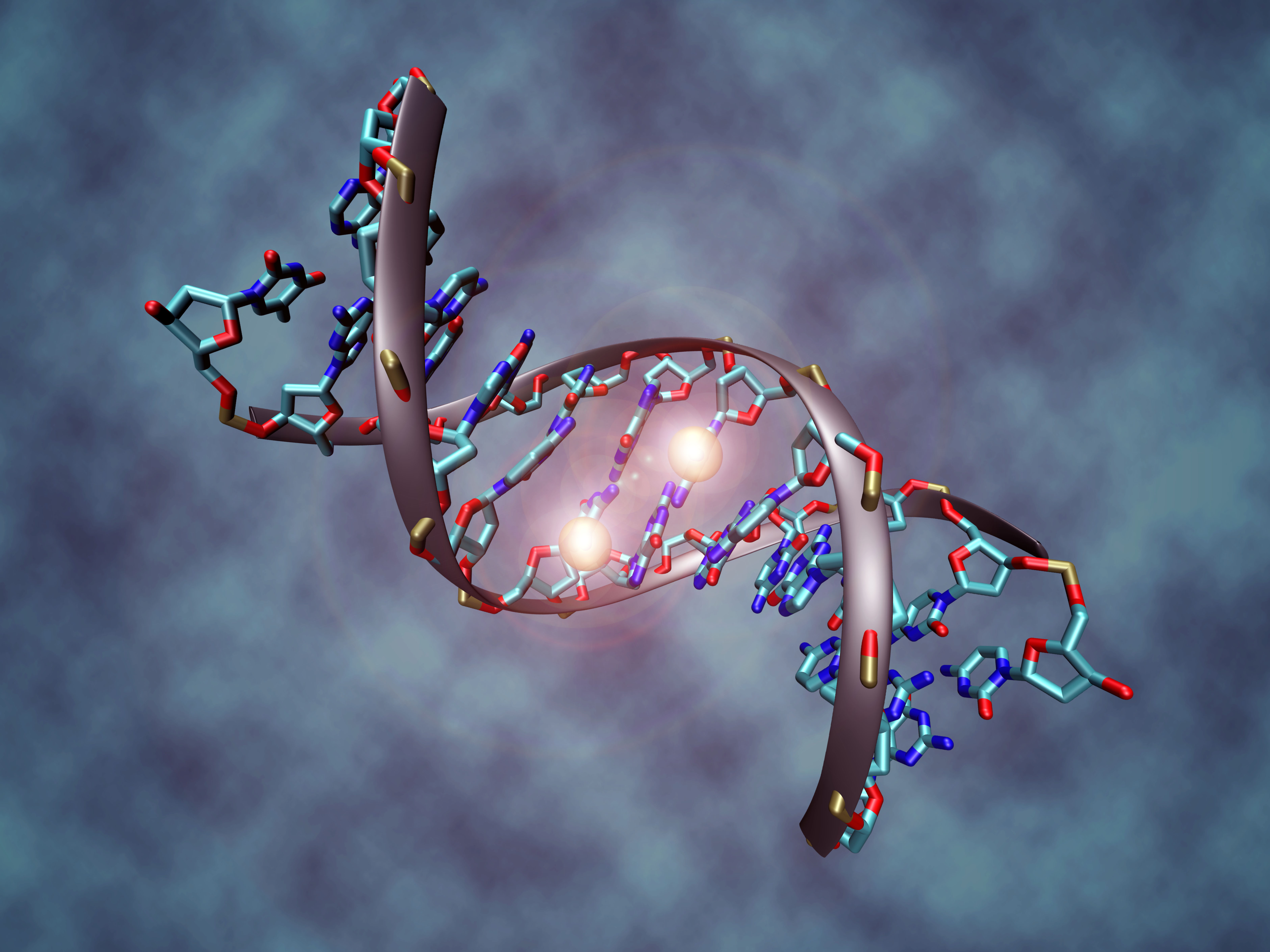
This image shows a DNA molecule that is methylated on both strands on the center cytosine.
Created by Christoph Bock (Max Planck Institute for Informatics) 2/18/2006.

The changes in methylation between groups 1 and 2 were not random. The affected genes were predominantly ones involved in insulin sensitivity, metabolism and vascular disease. Sure enough, the kids in group 2 had less obesity and lower blood pressure, and were less prone to autoimmune or vascular disease or diabetes.

To be clear, the scientists haven’t established that gastric bypass surgery itself leads directly to having offspring with an altered methylation pattern. The difference could have resulted simply from changes in body composition or eating habits in the mother, or from the altered microbial environment around the womb. But one way or another, the gestational environment of kids does appear to affect them profoundly. 

If you’re a woman with your reproductive years ahead of you who didn’t already have enough to worry about, you’re welcome.


Guénard, F., Deshaies, Y., Cianflone, K., Kral, J., Marceau, P., & Vohl, M. (2013). Differential methylation in glucoregulatory genes of offspring born before vs. after maternal gastrointestinal bypass surgery Proceedings of the National Academy of Sciences DOI: 10.1073/pnas.1216959110.


Wednesday, June 26, 2013

Just for fun: Nano sculptures

This beautiful flower is actually a tiny crystal (about 50 microns across) that was coaxed into forming these delicate shapes by manipulating the temperature, acidity and carbon dioxide level of the water in which it was grown.

INTELLIGENT DESIGN:


Spiky flowers grown on a base of budded globs show off the researchers’ ability to design complex forms using this new technique. 

Wim L. Noorduin, Harvard School of Engineering and Applied Sciences


You can see the rest of the slideshow here. The images were originally in black and white, by the way. The colors were added later. At first, I was disappointed to read that, but then I realized that it's really the shapes that are amazing.


Tuesday, June 25, 2013

Do dogs need a secure base?

Children look to their parents for security and for cues about how to react. Not only do children resist separation from their caretakers, but they also use those caretakers as a ‘secure base’ from which to explore their environments. Do dogs do the same thing with their owners? That’s the burning question addressed by Lisa Horn, Ludwig Huber and Friederike Range of the University of Vienna (and also from the Clever Dog Lab Society, which has to be the world’s greatest place to work).

Most young children are more willing to explore their environment, play with toys or tackle problem-solving tasks when their parents are close by. Like young children, dogs are wholly reliant on the adult humans around them. To test whether dogs also use their owners as a secure exploration base, the researchers presented the dogs with food-hiding toys under three experimental conditions: the owner was absent, the owner was present but blindfolded and thus did not engage with the dog at all (silent), or the owner was present and encouraging the dog to interact with the toy. Only by persistently manipulating the toy (apparatus) with their paws and mouth could the dog gain access to the food treat. 

You can see the set up here:

Figure 2 Schematic representation of the experimental set-up.
At the beginning of each trial, the dog was released by the experimenter from the release point, which was 2.5 m away from the toy. During each trial the experimenter stood on the right side of door 1 – timing the trial with a clock on the opposite wall. The owner either sat on the designated chair on the left side of door 1 or was in the adjacent room. 

Dogs were coded for time spent manipulating the toy (though not for successfully prizing the food out of it--this wasn’t a test for skill or intelligence) and time spent in proximity to either owner or experimenter (marked as having its head and at least one paw within the dotted lines).

Here were the results:

Figure 3 Duration of manipulating the apparatus –

It’s not surprising that the dogs worked on the toy puzzles longer when their owners were actively encouraging them to do so. But notice that the difference between the ‘silent’ and ‘encouraging’ owners wasn’t nearly as great as the differences between those conditions and the ones with the absent owners. Dogs also spent far more time close to the experimenter (who completely ignored the dogs and only watched the clock) when their owners were absent.

This seems like a clear indication that dogs are using their owners as secure bases for exploration. Except for one thing. Look what happens when the researchers substituted a blind-folded stranger (replaced owner) for the owner.

Figure 5 Duration of manipulating the apparatus –


As you can see, when a silent stranger took the owners’ place in the experiment, the dogs spent an intermediate amount of time manipulating the toy. Thus, the dogs showed a range of behaviors, displaying the least confidence when no one was in the chair and the most confidence when their own owners were encouraging them to keep interacting with the toy.

This could mean that any human can more or less serve as a secure base. Or it could be that dogs don’t use secure bases in the same way that children do. In any case, the authors suggest that, going forward, other canine researchers recognize that their test subjects might be affected by the presence or absence of their owners.

Horn, L., Huber, L., & Range, F. (2013). The Importance of the Secure Base Effect for Domestic Dogs – Evidence from a Manipulative Problem-Solving Task PLoS ONE, 8 (5) DOI: 10.1371/journal.pone.0065296.


Monday, June 24, 2013

Designated driver: I do not think that word means what you think it means

Because of the dangers of driving while under the influence of alcohol, it’s a great idea to choose a non-drinking driver before you head out on town. Unfortunately, Adam Barry, Beth Chaney and Michael Stellefson from the University of Florida found that many designated drivers are not always as sober as one could wish.

The researchers hung around a college town on Friday evenings and stopped patrons exiting bars between 10 pm and 2:30 am. Participants were given alcohol breathalyzer tests and asked a few questions, including their normal drinking habits and whether they were serving as a designated driver for that evening.

Designated drivers had lower blood alcohol levels than those who were not expecting to drive. That’s the good news. The bad news is that nearly 40% of people claiming to be designated drivers had not abstained from drinking. Eighteen percent of people who were serving as their friends’ safe ride home had blood alcohol levels above 0.05. While it’s currently legal to drive in the U.S. with a blood alcohol level below 0.08, there is no doubt that a person with a blood alcohol level of 0.05 is impaired, and the National Transportation Safety Board is recommending that 0.05 be the legal limit. Even a level of 0.02 can negatively affect driving.

It seems that to many revelers, ‘designated driver’ means ‘whoever is the least intoxicated’ or maybe even, 'whoever drives the best when they're drunk' rather than ‘someone who did not consume any alcohol’. That’s not good news either for the people relying on these designated drivers or for the other cars on the road.

Barry AE, Chaney BH, & Stellefson ML (2013). Breath alcohol concentrations of designated drivers. Journal of studies on alcohol and drugs, 74 (4), 509-13 PMID: 23739013.


Friday, June 21, 2013

Is this the end of the line for the Kepler Space Telescope?

The Kepler Space Telescope has been orbiting the sun since 2009, finding exoplanets at a surprising rate. During those 14 years, the Kepler has been responsible for confirming the existence of 132 planets and for discovering over three thousand possible exoplanet candidates. It has shown us that just about every star we see in the sky has planets, many of them potentially Earth-like.


Position of the Kepler space telescope. Note, objects in this video are not to scale. 

Unfortunately, the Kepler’s planet-hunting days may be behind it.

The Kepler uses the ‘transit method’ to find exoplanets. As a planet passes in front of its star from our vantage point, we see a slight dimming of the light coming from that star. If that dimming follows a regular pattern, we have a strong suspicion that an object is orbiting the star and that the object is most likely a planet. 

The Kepler telescope monitors a single patch of sky, continuously observing the same 100,000 plus stars. In order to do that job, the Kepler is kept in position by four reaction wheels. Three wheels are necessary to control orientation in each of the three dimensions and the fourth is a redundant spare. Last month, two of the wheels failed, leaving the telescope unable to maintain its precise orientation.

All may not be lost, however. Jacob Aron, writing at New Scientist suggests that the Kepler switch to another planet finding method, known as ‘gravitational microlensing’. This method relies on the fact that the gravitational pull of an object will bend and magnify the light coming from more distant stars. On the plus side, this type of detection does not require the tight spacial positioning that the transit method demands. On the minus side, microlensing is best suited for finding planets outside the habitable zone of their stars rather than for detecting Earth-like planets, which was Kepler’s original mission.


Gravitational microlensing schematic

An illustration of the gravitational microlensing technique, showing an Einstein ring. 
Credit: Timberlake Studios.

This week’s episode of the excellent Big Picture Science podcast discusses the Kepler in detail.


Thursday, June 20, 2013

How hot is too hot?

What’s the hottest environment in which living organisms can thrive? It depends on the organism. There are Archae (single-celled prokaryotes that used to be classified as bacteria) that have been found thriving in 122oC. Remember, that’s much hotter than the boiling point of water, and presumably of the insides of the Archae. 

Multicellular organisms can’t take that amount of heat. One of the most thermophilic (heat-loving) metazoan organisms ever discovered is the Pompeii worm (Alvinella pompejana, shown above). These are a type of bristle worm that happens to live next to hydrothermal vents on the ocean floor. Although they are known to live at temperatures of 50oC (that’s 122oF for my fellow Americans), some reports suggest that they can tolerate far hotter temperatures, even up to 100oC. 

The best way to test these assertions would be to systematically vary the temperature within a controlled setting. Unfortunately, it has been impossible to bring living Pompeii worms up from the depths of the ocean into the laboratory. Until now.

French researchers, led by Juliette Ravaux of Université Pierre et Marie Curie, designed an apparatus to snatch up the worms at the foot of a black smoker and maintain them under extreme pressure all the way to the surface, where they are transferred into a specially designed aquarium. 

Once in the lab, the specimens were subjected to three thermal regimes. One group was maintained at a balmy 20oC. A second had their environment  gradually increased to 42oC for two hours.  For the final group, the temperature was raised to 55oC for two hours, upon which point the worms would have been allowed to recover at 20oC if they hadn’t already been dead.

There was no discernible damage to the worms who were subjected to 42oC water. Not so with the unfortunate creatures who spent time at 55oC. Interestingly, the group that stayed at 20oC the entire time had a lower survival rate than the 42oC group.

While the Pompeii worm can withstand high temperatures, the reports of its heat tolerance are clearly exaggerated. Good to know.


Ravaux, J., Hamel, G., Zbinden, M., Tasiemski, A., Boutet, I., Léger, N., Tanguy, A., Jollivet, D., & Shillito, B. (2013). Thermal Limit for Metazoan Life in Question: In Vivo Heat Tolerance of the Pompeii Worm PLoS ONE, 8 (5) DOI: 10.1371/journal.pone.0064074.


Wednesday, June 19, 2013

Just for fun: XKCD

If you spend any time on science blogs, chances are you've come across the work of xkcd. The xkcd empire includes exceptionally sharp critiques of math, science, and nerd culture.

There are cartoons (and don't forgot to hover over them for extra content).

Ten Thousand


Including what may be the best cartoon of all time:


Duty Calls


A 'What If' page where hypothetical physics questions are answered (did you know how many giraffes high a person can throw a ball?).


And a twitter feed that offers a host of interesting numbers and measurements: