Science-- there's something for everyone

Sunday, June 12, 2011

The truth behind hummingbird tongues


University of Connecticut researchers Alejandro Rico-Guevara and Margaret Rubega used transparent artificial flowers and high-speed cameras to watch hummingbirds take their nectar meals. The resulting videos surprised even the scientists.

Conventional wisdom has it that hummingbirds use capillary action to such up their liquid diet. In other words, it was thought that the sugary liquids were drawn up by the surface tension of the liquid within the confines of the tiny hummingbird tongue tubes. One flaw in this theory is that hummingbirds routinely eat liquids with double the sugar levels that can be quickly brought up by capillary action alone.

By using their high tech cameras, the researchers found that the hummingbirds were actually using their tongues to enclose the fluids. Each hummingbird tongue contains two forks that can each curl inward to form two tiny tubes. As the tongue enters the nectar solution, the forks spread open. Over the next 15 milliseconds, those forks close into tubes, entrapping the enclosed liquid and bringing it into the bird's mouth. Hummingbirds can perform this act up to 20 times each second. The mechanism of opening and curling into tubes is so energy efficient that even the tongues of dead birds will open and shut when drawn in and out of sugar solutions.

Close-up views of a hummingbird's tongue. A tongue's two forks uncurl in nectar (top), but curl back up to trap the sugary fluid when leaving it (bottom).
Alejandro Rico Guevara/PNAS.


Saturday, June 11, 2011

Just for fun: Quadrocopter ball juggling


Mark Müller, Sergei Lupashin and Raffaello D'Andrea used the
Flying Machine Arena at ETH Zurich to put their 'quadrocopter' through its paces.


Hat tip: Skepchick.

Friday, June 10, 2011

The right mucus can expel worms


Although parasitic nematodes (sometimes called worms) infect up to a billion people worldwide, a few people seem to be naturally immune to the little invaders. Researchers from the University of Manchester, the University of Texas and the NIH may have discovered the secret of their success. They make the right kind of intestinal mucus.
We all have a thick layer of mucus in our guts. Among its other components are proteins called ‘mucins’. It’s these sugar-coated mucins that are responsible for the gel-like properties of mucus. Upon closer examination, the scientists found that mice that were able to rid themselves of parasitic nematodes (specifically the whipworm Trichuris muris) contained the mucin Muc5ac. The hapless mice that did not have this particular mucin could not expel the nematodes.

The mouse whipworm Trichuris muris.
Credit: R. Grencis
Very similar types of intestinal nematodes infect humans, some of whom also make the Muc5ac mucin. Those people can efficiently eliminate not only whipworms, but other types of nematodes as well (hook worms and spiral threadworms).

Mice that make Muc5ac are a small minority. It’s not yet clear what percentage of the human population makes this mucin and thus is largely immune to nematode infection. However, this new data could help doctors determine which individuals are susceptible to parasitic worms and potentially create treatments for those that are.

Thursday, June 9, 2011

Cats prey on birds


Okay, this title isn’t exactly news. We all know that if given the chance, cats will stalk birds. What you may not know is the extent to which this predation goes on. According to work by Christine Stracey, a graduate student at the University of Florida, cats are by far the number one predator of urban mockingbirds.

Previous studies have demonstrated cat predation on adult bird populations. This time, the researchers wondered whether cats were also responsible for attacking nests. To test this, Stracey and her colleagues placed small security cameras near mockingbird nests. Sure enough, cats came in as the top predators by a huge margin. To be fair, this was only true in urban regions. In rural settings, hawks were the main predators. In either case, the videos documented predators attacking not adult birds, but eggs and nestlings. Videos were placed only around mockingbird nests, but the researchers expect to find similar rates of predation around other birds’ nests.

graph of predators

Although the researchers could not identify individual cats, at least some of them were wearing collars, indicating that they were not feral. All but one of the cat predation events occurred at night. For this reason, Stracey makes the following plea:
Please, at the very least, keep your cats indoors at night.
On the other hand, a new study showing that cats are responsible for spreading Toxoplasma gondii infections through wildlife suggests that cats should be indoors all the time.

Wednesday, June 8, 2011

Babies sleep to grow


Michelle Lampl from Emory University and Michael Johnson from the University of Virginia Health System have documented something we all suspected was true: infants sleep more just before they grow.

The researchers compared daily sleep patterns in 23 babies for up to seventeen months. Rather than relying on parental recall, the scientists asked the parents to record sleep onset and waking in real time, as well as keeping notes on infant feeding and illness. Periods of longer total sleep time occurred just before increases in weight, body-fat composition and length.

Interestingly, baby boys tended to increase the lengths of their normal sleep periods, whereas baby girls tended to add more naps. However, it was the total increase in sleep hours that predicted the growth spurts.


Tuesday, June 7, 2011

Eavesdropping on insect pests


Insect pests can be a huge problem both in the home and in food storage and processing areas. Although there are many methods of combating these little invaders, the entomologists at the Agricultural Research Service (ARS) wanted a better way to monitor those efforts. To that end, the researchers devised a way to listen to insects’ movements.

Richard Mankin of ARS and his colleagues from ARS, North Carolina State University and the University of Florida built a monitoring system that collects infrared, acoustic and vibrational signals. Those signals correspond to typical insect movements (running, wriggling or scraping across a surface). The data can be sent to users’ laptops, thus eliminating the need to frequently check problem areas. Storage facilities like warehouses or grain elevators can be remotely monitored for insect infestation.

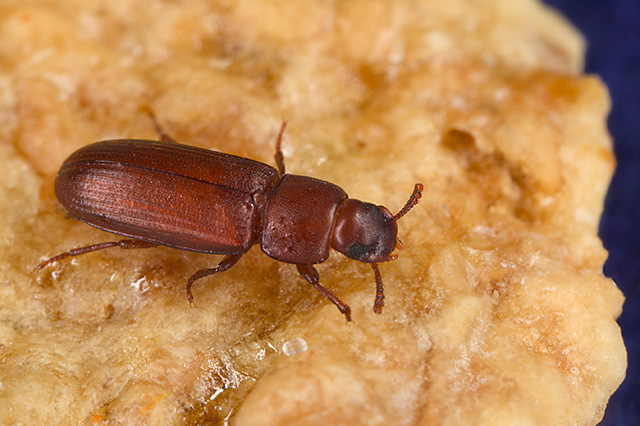
Thus far, the scientists have successfully located and identified five test insects: rice weevil, red flour beetles and drugstore beetles (agricultural pests), and German cockroaches and bed bugs (household pests). In case you’re interested, red flour beetles (pictured above) tend to wriggle, cockroaches run or crawl, and bed bugs scrape along.


Monday, June 6, 2011

Nutcracker man was really a grass eater


Paranthropus boisei (nicknamed ‘nutcracker man’), a hominid living from 2.3 to 1.2 million years ago, was long thought to have had a diet consisting mainly of nuts and seeds. It certainly had the massive jaws and molars required to tackle that sort of fare. However, new research on P. boisei’s fossilized teeth has shown that the hominids were mis-nicknamed. In fact, the creatures ate mostly grasses.

Thure Cerling of the University of Utah and his colleagues from the University of Colorado, Stony Brook University, the Turkana Basin Institute, and the National Museums of Kenya used carbon isotope ratios to determine what the animals ate.
Plants use different metabolic pathways to incorporate carbon into their cells, and thus into the entire food chain. Briefly, C3 carbon fixation (used by about 95% of the plants on Earth) results in a different ratio of the isotopes carbon-12 and carbon-13 than does C4 carbon fixation (used mainly by grasses and sedges). Cerling’s team found that the carbon isotope ratios in 24 teeth from 22 different P. boisei individuals indicated that the creatures’ diets was about 77% C4 plants. This is comparable to grass-eaters of the time, such as the ancestors of modern zebras.

Meanwhile, Peter Ungar and his colleagues from the University of Arkansas examined microscopic scratches and wear patterns in the enamel of the P. boisei teeth. These too indicate a pattern of dining on grasses, rather than of cracking nuts or other hard objects. Taken together, we have strong evidence that at least one member of the hominid family was competing with the local cows at the dinner table.

You can see explanations by Peter Ungar in the following two clips, both from the National Science Foundation.