Science-- there's something for everyone

Tuesday, November 1, 2011

Dark matter more confusing than ever


Don’t you love a scientific study that concludes, “after completing this study, we know less … than we did before”?  So says Matt Walker of the Harvard-Smithsonian Center for Astrophysics about dark matter.

In the standard cosmological model, most of our universe is made up of stuff we can’t detect.  We infer its existence from the effects it has on regular matter (ordinary stuff made of atoms).  Astronomers now suspect that there is five times as much of this 'dark matter' as regular matter in the universe. 

Dwarf galaxies are particularly good dark matter caches, containing up to 99% dark matter.  Current models predict that most of that dark matter should be compressed into the center of those galaxies.  However, new measurements conducted by Walker and Jorge Peñarrubia from the University of Cambridge showed that the dark matter was smoothly distributed throughout at least two dwarf galaxies.  This is inconsistent with the ideas that dark matter bunches together forming the nuclei of galaxies, and that these clumps attract normal matter.

Clearly, dark matter isn’t what we thought it was.  Or should I say, ‘opaquely’?

Monday, October 31, 2011

Wasp vs. ant


If there’s anything creepier than insects that lay their eggs inside other insects so their larvae can feast on the living flesh of their prey, I’m not sure what it is.  For your Halloween viewing pleasure, José-María Gómez Durán and Cornelis van Achterberg of NCB Naturalis Leiden have managed to film and describe four species of parasitoid wasps in the act of depositing their eggs in ants.  Two of the wasp species are new to science.

As you can see in the video below, the wasps use the strategy of attacking from above and behind the ants.  This technique is highly affective, resulting in an 80% success rate in depositing eggs.  Don’t be fooled by the slow motion in the video.  The entire sequence from landing on an ant to taking off again lasts less than three quarters of a second.


If that wasn’t enough for you, check out videos two, three and four.

By the way, parasitoids differ from other types of parasites in that they always kill their victims.  In other words, the hapless ants in the video are doomed to an extremely unpleasant death.

Sunday, October 30, 2011

Amorphous diamond?


Yu Lin and Wendy Mao of Stanford University have succeeded in making what they call ‘an amorphous diamond’.  You may be wondering, as I was, what an amorphous diamond is and why it isn’t a non sequitur.

As you may already know, in addition to being the hardest naturally occurring material, diamonds are a crystalline, or highly ordered, form of pure carbon.  In contrast, amorphous substances have no repeating patterns.  They are by definition non-crystalline. It already doesn’t look good for ‘amorphous diamonds’.

To make their new material, the researchers took tiny beads of amorphous carbon and smashed them with over 400,000 atmospheres of pressure.  As a result, the bonds within the carbon beads shifted, making the resulting material as hard as diamonds (based on further pressure tests).  Yet, the beads did not become crystalline but stayed amorphous. 

The ‘amorphous diamond’ could turn out to be a very useful product.  Like oobleck, it’s only hard under extreme pressure. Once the pressure is released, the material returns to a softer state.  This means that the material may be tunable, responding to the amount of hardness required.  Not a bad feature in a structural component.

That said, in my opinion, ‘amorphous diamond’ is a non sequitur.  I think the authors are using the name ‘diamond’ as shorthand for ‘substance that is harder than anything else on Earth—I mean, this thing is really hard!  You won’t believe how hard it is!’.

Saturday, October 29, 2011

Just for Fun: Quantum levitation


Check out this amazing demonstration of a quantum superconductor locked in a magnetic field, presented by Tel-Aviv University at the 2011 Association of Science-Technology Centers Annual Conference.


Wonder how that works?  Here's the explanation.


Hat tip:  Pharyngula.

Friday, October 28, 2011

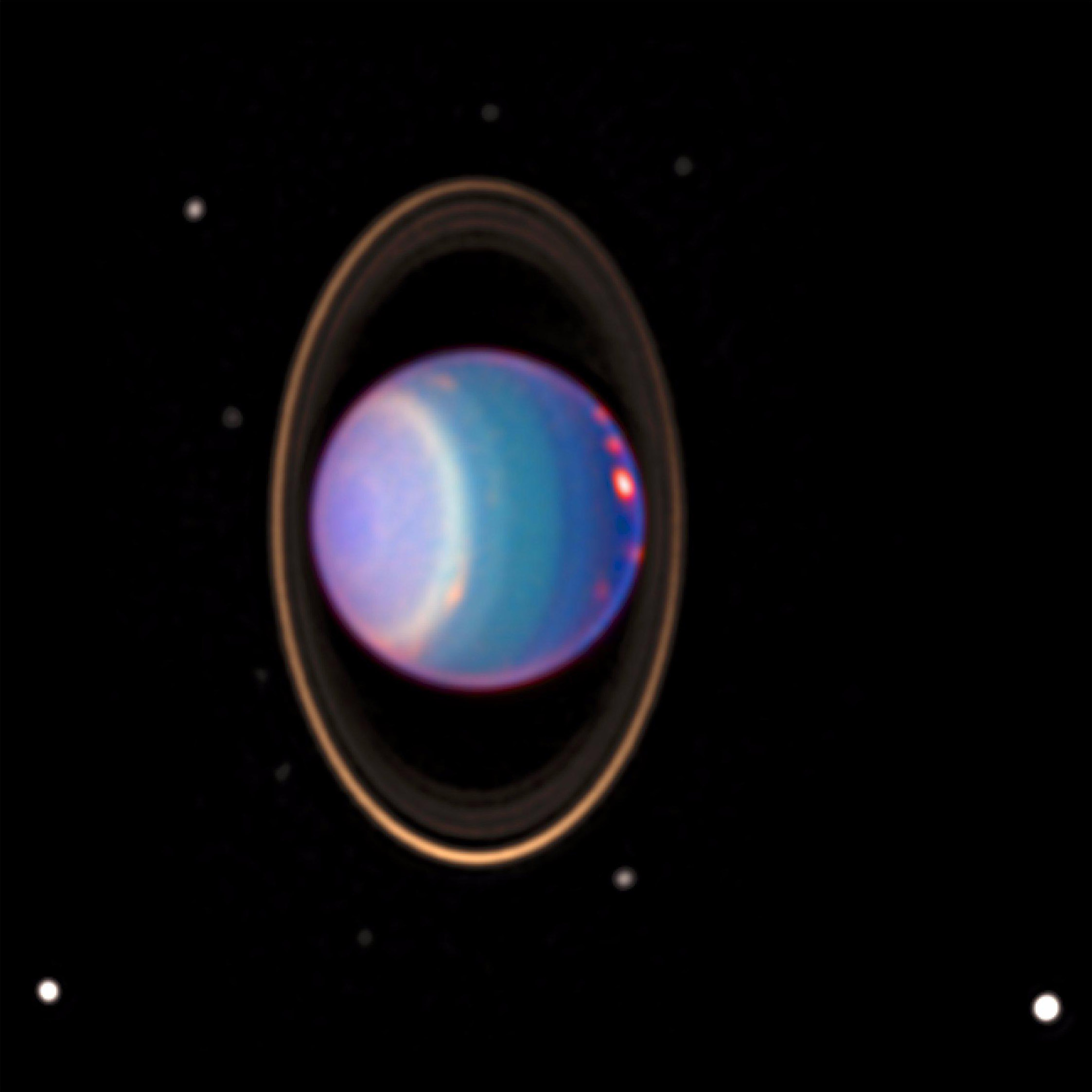
More than one blow to knock Uranus over


Alessandro Morbidelli from the Observatoire de la Cote d’Azur, Nice led an international team of cosmologists in answering a longstanding question:  How did Uranus get its tilt?  Computer simulations indicate that it took at least two thumps from planet-sized bodies.

Uranus is unusual in that its rotational axis is almost perpendicular to the plane of its orbit around the sun.  In other words, it’s spinning on its side.  Other planets have some degree of tilt, the Earth is tilted by 23 degrees (which accounts for our seasons), but none come close to the 98 degree tilt of Uranus.

Until recently, astronomers thought that a single collision with an object larger than the Earth knocked Uranus onto its side.  However, in that scenario, Uranus’s moons should have remained in the horizontal plane (orbiting around Uranus pole to pole).  Instead, they apparently flipped over when Uranus did and now orbit in the plane of Uranus’s equator.  A single collision could not account for rotating the entire Uranus plus moons system.  In contrast, two or more smaller collisions occurring before the moons were fully formed could have resulted in the system we see today.

Thursday, October 27, 2011

The evolution of flight, as performed by robots


How did birds develop flight?  There are two competing theories about this.  First, that birds ran along the ground until, by flapping their progressively more powerful wings, they could finally take off.  Second, that birds glided down from tree branches or other heights, extending their range by flapping their wings.  In each case, smaller less powerful wings would give some advantage even if they didn’t convey actual flight.  So which scenario was more likely?  According to research done by Ron Fearing and his Berkeley students, the second narrative may be the more apt.  And you may be surprised to learn that they draw this conclusion from studying robots.

Fearing and his team added motorized flapping wings to a small six legged robot called DASH (Dynamic Autonomous Sprawled Hexapod).  The original DASH, developed in 2009, was having some problems negotiating inclines and other obstacles.  DASH+Wings was not only more stable and agile, but also much quicker, nearly doubling in speed. You can watch some of the tests below, slowed to 1/10th speed.


What does this have to do with the evolution of flight?  Even with the impressive doubling of ground speed the robot was not able to get air born.  In fact, computer models suggest that to achieve liftoff, an animal would have to triple its running speed.  If DASH+Wings is a reasonable model of a running animal, this data implies that flight could not have developed from the ground up.  That’s a big if though.  Obviously, this question is not settled yet.  However, it’s interesting to think that the question of how flight evolved might one day be resolved by watching robots.

Wednesday, October 26, 2011

Easy wake alarm


When I was a kid, my brother and I played a board game called ‘The Inventors’ which featured an ‘E-Z wake alarm’.  This alarm system was essentially a rope tied to a payload precariously placed above the sleeper’s head.  Jemina Sylvia from the Jerusalem College of Engineering led a team in developing a gentler way to wake people up.  They link their alarm clock to the slumberer’s electroencephalography (EEG) waves so that he or she can be awoken during the least jarring part of the sleep cycle.

As people doze, they alternate between rapid eye movement or REM sleep, the stage at which most dreaming occurs, and non-REM sleep.  There are four stages of non-REM sleep, each progressively deeper than the previous stage. The various sleep stages can be distinguished by EEG waves.  As you can see in the hypnogram below, most people follow 90 minute patterns of REM through stage 4, then REM again.

In this study, volunteers were hooked up to EEG monitors as they slept, and the output was sent to their alarm clocks, which were programmed not to awaken them if they were in stage 3 or 4.  Instead, the clock waited until the sleeper was in one of the lighter sleep stages before sounding.

As of now, the device has some drawbacks, not least of which is that the sleeper has to wear scalp electrodes that are wired to a clock—not exactly what the person seeking a more pleasant sleep experience is looking for.  However, the researchers expect that a headband containing wireless electrodes could do the trick.  And of course, there’s the question of whether people will be late for appointments if their clocks wait for a more convenient time to wake them.