Science-- there's something for everyone

Monday, June 10, 2013

Flying a helicopter with your mind

Okay, it’s only a toy helicopter. Still, the fact that Bin He and his team from the University of Minnesota have been able to put a remote-controlled quadcopter through its aerial paces using only the power of their thoughts is pretty amazing.

Five subjects, which the researchers specifically describe as ‘human’ in case you were wondering, were trained to move a cursor on a screen by imagining that they were squeezing one or both of their fists. They then used the same techniques to control first a virtual quadcopter and then a real one. All five participants were successful in making the robot fly in a chosen direction, including through rings. 

While controlling toys with your mind might be cool, the researchers are really looking forward to using their technique to help paralyzed people control every day electronic objects. The key thing about this technology is that it’s completely non-invasive, meaning that it does not require any surgical implants. You do have to wear the funny electroencephalogram bonnet though.

You can see the a clip of the experiments below:


In case it isn’t clear from the video, the controller is facing away from the quadcopter. A camera mounted on the quadcopter gives the subject a first person view on his computer monitor. 


LaFleur, K., Cassady, K., Doud, A., Shades, K., Rogin, E., & He, B. (2013). Quadcopter control in three-dimensional space using a noninvasive motor imagery-based brain–computer interface Journal of Neural Engineering, 10 (4) DOI: 10.1088/1741-2560/10/4/046003.


Friday, June 7, 2013

Did caves drive us to our feet?

Why did early hominins leave the trees and begin to walk upright? Conventional wisdom has it that we rose up on our hind legs in order to better traverse the savannah that had replaced our forested homes. Not necessarily, say Isabelle Winder of the University of York and her colleagues. Our evolutionary ancestors may have discovered the advantages of bipedal locomotion while clambering about rocky outcrops and caves. 

The authors provide the following graphic to explain their idea.


They suggest that early humans would have found the uneven terrain of broken ground attractive, both for safety and for opportunities to trap prey. Thanks to volcanoes and shifting tectonic plates, the landscape of East and South Africa would have included plenty of gorges and caves for hominins to scramble over.

Needless to say, this hypothesis is only one in a large number of ideas about how we came to walk upright. There’s even some evidence that we became more or less bipedal before we left the trees. Still, it’s interesting to think about our ancestors actually being cavemen.

Isabelle C. Winder, Geoffrey C.P. King, Maud Devès, & Geoff N. Bailey (2013). Complex topography and human evolution: the missing link 2013 Antiquity. 87:336 p333-349.

Thursday, June 6, 2013

How did plants develop photosynthesis?

You don't usually think about green algae being carnivorous. In fact, it's hard to imagine a more placid life form. However, the habits of one type of modern green algae (Cymbomonas) is helping Shinichrio Maruyama of Dalhousie University and Eunsoo Kim, Assistant Curator of Invertebrate Zoology at the American Museum of Natural History answer the question of how algae went green in the first place. 

Endosymbiotic theory is a well accepted explanation for how plants acquired chloroplasts (the organelles responsible for photosynthesis). About one and a half billion years ago, primitive single-celled organisms dined on photosynthetic bacteria (cyanobacteria). Rather than being digested, the cyanobacteria became permanent residents within the larger cells. 

Among the more compelling evidence for this is the fact that chloroplasts (like mitochondria, which have a similar provenance), have their own separate genomes. Chloroplasts also replicate independently from their host cells. Despite these and other lines of evidence, we had no proof that the endosymbiotic theory is correct. There aren't any plasmid-less cells that we can observe in the act of engulfing cyanobacteria.

This is where Cymbomonas, an algae that closely resembles its early ancestors, comes in. With a bit of coaxing, or more specifically by turning the lights out to preclude the use of photosynthesis, the researchers persuaded the algae to consume bacteria to fulfill their energy requirements. Cellular stains and electron microscopy were used to confirm the process.

Below is an electron micrograph of an alga that has made a meal of bacteria.


Caption: This transmission electron micrograph shows bacteria-feeding in the green alga Cymbomonas. In the cross-section features a large vacuole (v) containing bacterial cells. It also shows the tubular duct (d) that transports food into the vacuole. Other structures pictured are plastids/chloroplasts (p), a mitochondrion (m), and Golgi bodies (g). The scale bar represents 2 micrometers.
Credit: AMNH/E. Kim
And a clip of Kim explaining the results:


This still doesn't prove that chloroplasts originated as independent bacteria, but it does show that the kind of ingestion and capture required for that sort of event is possible. When added to all the other evidence, it makes the endosymbiotic theory all but a certainty.

Maruyama, S., & Kim, E. (2013). A Modern Descendant of Early Green Algal Phagotrophs Current Biology DOI: 10.1016/j.cub.2013.04.063.


Wednesday, June 5, 2013

Just for fun: Krebs cycle song

Apparently, the intermediary metabolism students at the University of Ottawa are challenged to write a song about the Krebs cycle (the way we metabolize the foods we eat into the energy our cells can use, aka the tricarboxylic acid cycle). Wilson Lam came through with the following offering. You may recognize the tune.


Catchy, right?

Hat tip: Not Exactly Rocket Science.


Tuesday, June 4, 2013

Top 10 New Species of 2012

Arizona State University’s International Institute for Species Exploration has come up with their 6th annual list of the top ten newly discovered species. 

To make the cut, a species has to have been officially named in 2012, though it might have been discovered, collected or even lived much earlier. Case in point, a 165 million year old hangingfly (Juracimbrophlebia ginkgofolia), or rather, the fossil of a hangingfly, that made the grade. 

You can see a collage of the winners below:
Top 10 new species announced by International Institute for Species Exploration at Arizona State University. (Credit: ASU)

One I particularly liked is the Night-Light cockroach (Lucihormetica luckae), which lived in Ecuador near the Tungurahua volocano. I say 'lived' because no more have been seen since the volcano erupted in 2010. The specimen below was collected seventy years ago (though officially described last year, as per the rules). It may already be extinct. 

Picture of a new species of glow-in-the-dark cockroach

Images courtesy Peter Vrsansky, Slovak Academy of Sciences.

Best comment from Berni Timmerman: on the National Geographic page (where you can see the rest of the winners):
The cockroach is just like Eva from Wall-e!!!


Monday, June 3, 2013

Flame Challenge 2013

The winners of the 2013 Flame Challenge were announced yesterday at the World Science Festival in New York. This year's challenge was to explain the concept of 'time' to eleven year old judges. 

Since this is my blog, I'm posting the video entry that I liked best, even though it didn't win the top prize. It was created by John Suchoki of Saint Michael's College in Vermont. You can see the top written and video entries here.


Or you can watch the Flame Challenge award ceremony:


Friday, May 31, 2013

Why did flightless birds evolve?

Why did some species of birds evolve flightlessness? According to Kyle Elliott from the University of Manitoba and his colleagues, sea birds probably traded flying for diving. Okay, that seems pretty obvious so far, until you ask why birds can't do both. In fact, there are species of birds that can both fly and dive, notably the murres and cormorants examined in this study. So why give up flight? The answer may be because of energy expenditure and efficiency.

We’re so used to the fact that penguins are flightless that it seems like the natural state for these birds. However, the ability to fly was an advantage not to be discarded lightly. After all, being able to fly would actually be quite handy for birds that migrate vast distances, not to mention for quick escapes from sharks and orcas. Unfortunately, the better adapted your body is to swimming and diving, in terms of biomechanics and energy costs, the less adapted it is for flying.

The researchers compared the flying and diving energy costs in murres and penguins, which dive using their wings to propel themselves, and in cormorants, which dive using their feet to propel themselves. Of the three groups, only penguins are flightless. 


Pelagic cormorant (Phalacrocorax pelagicus)
By Ingrid Taylar, 9/8/2011.

During flight, murres expended the most energy, far more than similarly sized birds, and more than cormorants. Remember, murres use their wings for both flying and swimming. During dives, penguins expended the least amount of energy, followed by murres and then cormorants. 


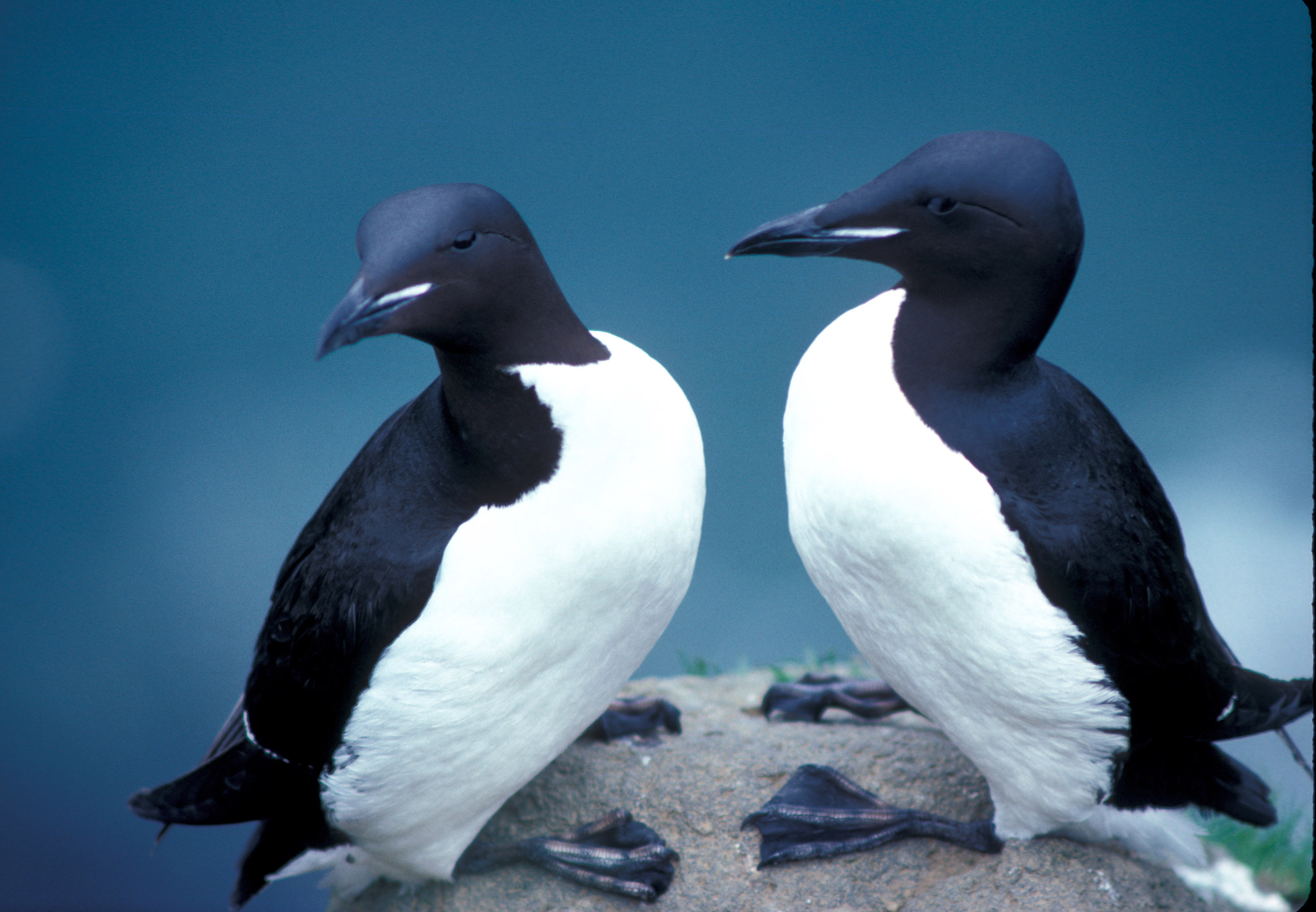
Thick-billed Murres (Uria lomvia)

These data suggest that wings can be great for flying or swimming, but not both. Murres, which do use their wings for both flying and diving, are mediocre at both. Cormorants reserve their wings for flying and so expend less energy flying and more energy diving. Penguins, which have devoted their wing structure solely to swimming, expend the least amount of energy doing so. 

I guess the lesson here is that if you really want to do something well, you have to specialize.


Elliott, K., Ricklefs, R., Gaston, A., Hatch, S., Speakman, J., & Davoren, G. (2013). High flight costs, but low dive costs, in auks support the biomechanical hypothesis for flightlessness in penguins Proceedings of the National Academy of Sciences DOI: 10.1073/pnas.1304838110.