Cornell University students Ray Li and Michael Ndubuisi have created a new way to make music. Their instrument is called the 'Aura' and relies on the movement of sensors across a magnetic field. That's description doesn't do it justice though. It's more like something you'd see on The Sorcerer's Apprentice.
Wednesday, April 2, 2014


Tuesday, April 1, 2014
April Fool's animal style
If animals played April Fool's jokes on each other, it would be by using mimicry and camouflage.
One of the great masters of tricking other animals is the Indonesian mimic octopus:
Camouflage is widespread in the animal kingdom, but here's one I particularly like: the pygmy seahorse.

The tiny creatures (no more than an inch long when fully stretched) were first discovered by scientists examining some coral they had in their laboratory. Imagine their surprise!
Monday, March 31, 2014
Diagnosing concussion with a blood sample
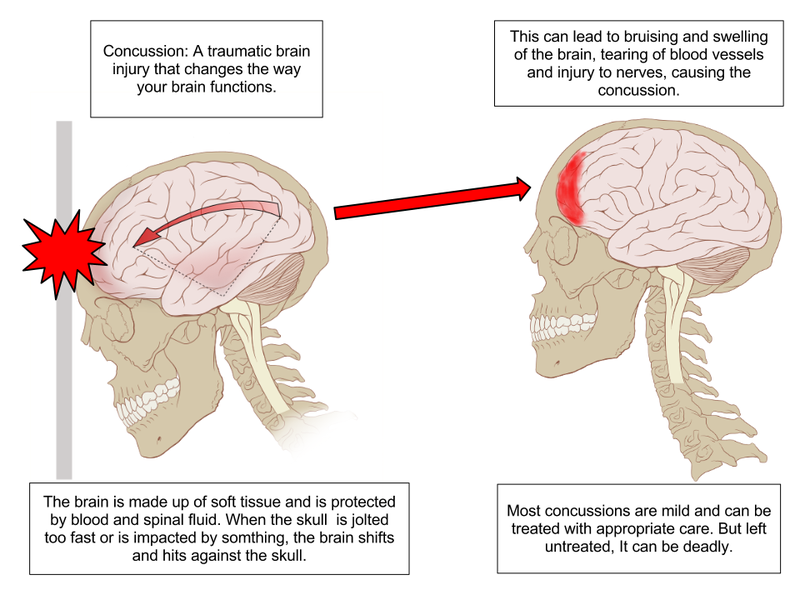 |
Image by Concussion mechanics.svg, 5/18/2012
|

There’s been a lot of attention paid of late to the problem of diagnosing concussions. How can you tell if an athlete has suffered a concussion, in which case he should be removed from play? One way is to look for biochemical markers. For example, boxers have increased levels of total tau proteins (T-tau) in their cerebrospinal fluid that correlate with the number and severity of the head blows they receive. Unfortunately, you can only analyze cerebrospinal fluid by doing lumbar punctures, which require a certain level of expertise.
Therefore, it would be nice to be able to detect a concussion biomarker with a simple blood draw. Luckily, there is now an ultra sensitive digital immunoassay that can measure T-tau in blood samples. Scientists led by Pashtun Shahim of Sahlgrenska Academy at the University of Gothenburg used the new method to quantify levels T-tau in the blood serum of hockey players.
Out of 288 players in the Swedish Hockey League, researchers took blood tests from 47 prior to the start of their professional season. During the season, 35 athletes suffered concussions (based on current guidelines), and 28 of them provided blood samples at 1, 12, 36, and 48 hours and 144 hours after the injury. It should be noted that these 28 were not necessarily the same men who had given the pre-concussion samples.
T-tau was significantly increased in all the post-concussion samples with the highest levels measured during the first hour. T-tau was also higher in players with more severe concussions, like those who had lost consciousness. This means that T-tau levels immediately after concussion could be used to predict when an athlete could safely return to play.
Obviously, these results are mere correlations at this point. And of course, we don’t have baseline measurements of the same people pre and post-concussion. However, if the results do pan out, measuring blood levels of T-tau could be a valuable tool in determining which athletes should be cleared for competition.
 Shahim, P., Tegner, Y., Wilson, D., Randall, J., Skillbäck, T., Pazooki, D., Kallberg, B., Blennow, K., & Zetterberg, H. (2014). Blood Biomarkers for Brain Injury in Concussed Professional Ice Hockey Players JAMA Neurology DOI: 10.1001/jamaneurol.2014.367.
Friday, March 28, 2014
An argument for the environmental cause of autism
Although we still don’t have a definitive cause for autism spectrum disorders (ASD), we know there is a strong genetic component. Cases of ASD tend to cluster in families and many specific genes have been implicated. However, that doesn’t mean that those genetic changes weren’t caused by environmental factors that acted during fetal development.
Researchers led by Andrey Rzhetsky of the University of Chicago scoured the insurance claims of roughly one third of the U.S. population looking for incidences of ASD. They compared those rates, county by county across the country, with the rate of birth defects in the reproductive systems of baby boys. The idea was that the birth malformations would indicate whether the parents had been exposed to environmental toxins like pesticides.
Sure enough, regions with higher rates of congenital malformations also had higher rates of ASD. For every 1% increase in birth defects there was a 283% higher incidence of ASD. This suggests that whatever is causing the increase in birth defects is also causing ASD.
To be clear, this is no more than an association. We don’t know for sure that environmental toxins are responsible for causing ASD, let alone which toxins. It is interesting that the male genetic structures form in the fetus at about the same time as neurons appear within the developing brain. Thus, exposure at that time could affect both or either developing organs.
If there is a an environmental factor causing ASD, it is felt prenatally, and perhaps even before conception (if the parents' germ cells were affected). By the time the baby is born, the damage has already been done.
 Rzhetsky, A., Bagley, S., Wang, K., Lyttle, C., Cook, E., Altman, R., & Gibbons, R. (2014). Environmental and State-Level Regulatory Factors Affect the Incidence of Autism and Intellectual Disability PLoS Computational Biology, 10 (3) DOI: 10.1371/journal.pcbi.1003518.
Researchers led by Andrey Rzhetsky of the University of Chicago scoured the insurance claims of roughly one third of the U.S. population looking for incidences of ASD. They compared those rates, county by county across the country, with the rate of birth defects in the reproductive systems of baby boys. The idea was that the birth malformations would indicate whether the parents had been exposed to environmental toxins like pesticides.
Sure enough, regions with higher rates of congenital malformations also had higher rates of ASD. For every 1% increase in birth defects there was a 283% higher incidence of ASD. This suggests that whatever is causing the increase in birth defects is also causing ASD.
To be clear, this is no more than an association. We don’t know for sure that environmental toxins are responsible for causing ASD, let alone which toxins. It is interesting that the male genetic structures form in the fetus at about the same time as neurons appear within the developing brain. Thus, exposure at that time could affect both or either developing organs.
If there is a an environmental factor causing ASD, it is felt prenatally, and perhaps even before conception (if the parents' germ cells were affected). By the time the baby is born, the damage has already been done.
Rzhetsky, A., Bagley, S., Wang, K., Lyttle, C., Cook, E., Altman, R., & Gibbons, R. (2014). Environmental and State-Level Regulatory Factors Affect the Incidence of Autism and Intellectual Disability PLoS Computational Biology, 10 (3) DOI: 10.1371/journal.pcbi.1003518.Thursday, March 27, 2014
Internal food webs
 |
| This is the parasite food web containing 10 groups of clustered parasites, tissues, and immune responses. Credit: Dr. Griffiths |
Last year, I wrote about researchers adding parasites to food web diagrams. You can’t really understand the dynamic interactions within an ecosystem if you don’t take parasites into account. Well, that’s just as much true inside a body as out. We play host to a complex community of microorganisms. Understanding how different parasites interact with each other within our bodies could play a key roll in defeating them.
In particular, does the presence of one type of virus or fungi inhibit or promote the growth of another? Would treating a bacterial infection give protozoans free reign to roam the body?
To begin to answer those questions, Emily Griffiths, formerly at University of Sheffield but currently at North Carolina State University, and her colleagues pored through published papers to find cases of multiple infection. From those reports, the researchers constructed a network of interactions showing links between parasites, immune system components that could attack those parasites, and the host resources that the parasites could consume.
The authors found that most parasites are only indirectly linked to each other. In other words, they don’t care what other parasites are doing or even whether they are present at all. This is not different from most free-living species, who also do not care what other organisms are doing, so long as those creatures don’t try to eat them. Where parasites did interact, it was more likely to be by sharing food resources rather than by eliciting the same immune responses.
Like in real estate, the most important thing in parasitism seems to be location. The scientists found ten tightly bound communities of parasites, eight of which were associated with particular body parts. You can see a cartoon of this finding at the top.
Griffiths, E., Pedersen, A., Fenton, A., & Petchey, O. (2014). Analysis of a summary network of co-infection in humans reveals that parasites interact most via shared resources Proceedings of the Royal Society B: Biological Sciences, 281 (1782), 20132286-20132286 DOI: 10.1098/rspb.2013.2286.Wednesday, March 26, 2014
Just for fun: The peacock spider
Do you like peacock spiders? Then you'll want to visit the YouTube channel Peacockspiderman maintained by cinematographer Jürgen Otto. Do you not know what peacock spiders are? Then you'll definitely want to visit that channel. Here's a sample:
Here's Dr. Otto's narration of the events. Note how tiny the spiders are:
More about peacock spiders here, by Gwen Pearson, aka Bug Girl.
Here's Dr. Otto's narration of the events. Note how tiny the spiders are:
More about peacock spiders here, by Gwen Pearson, aka Bug Girl.
Tuesday, March 25, 2014
Healthy food choices don’t hurt concession stands
 We’re all well aware of the obesity epidemic our nation is facing and of the accompanying health risks. We also know that an important part of combatting childhood obesity is to offer healthy food choices. That being the case, why not sell nutritious items at high school concession stands during games? That’s the question that Helena Laroche of the University of Iowa and her colleagues set out to answer.
To begin with, it’s important to note that concession stands make up a very important source of revenue for their schools, helping to fund student organizations and sports teams. Clubs running the food stands can be reluctant to change the menu for fear of hurting sales. Not only could spectators fail to buy healthier snacks, but seeing them on the menu might drive people away from the concession stand all together.
To see if that was the case, researchers collected data from concession stands in one Iowa High School (1700 students) over two seasons. The first year, the stand offered its usual menu. The second year, the usual foods were sold along with some healthier variations (nachos made without trans fats, for example) plus some new items including fruits and vegetables. None of the new items contained trans fats, and all had been selected from a preference survey given to students and parents.
Profits from the concession stands did not differ between the two years. In other words, having healthy choices did not deter people from buying snacks. So far so good. But were people selecting the healthier options? They were. About 9% of the total revenue was due to the purchase of the new, healthier items. More importantly, sales for those healthier choices continued to increase game after game, indicating that the public liked having them on the menu.
Author Brian Wansink of Cornell University exuberantly explains:
Laroche, H., Ford, C., Hansen, K., Cai, X., Just, D., Hanks, A., & Wansink, B. (2014). Concession stand makeovers: a pilot study of offering healthy foods at high school concession stands Journal of Public Health DOI: 10.1093/pubmed/fdu015.
Subscribe to:
Posts (Atom)