Science-- there's something for everyone

Tuesday, February 11, 2014

Bad news for astronauts—microgravity can affect your immune system

Being in space can affect you in ways you may not have considered. Retired Canadian astronaut and total rock star Chris Hadfield has scores of videos explaining exactly what life was like on board the International Space Station. Among those effects are problems with the immune system.

As far as gravity is concerned, spaceflight can be divided into two components. You’re exposed to hypergravity during launch and landing. Most of the time in between those events, there is microgravity. Researchers led by Katherine Taylor of the University of California Davis and her colleagues used some space-faring flies (Drosophila) to figure out how our immune systems might be compromised by those changes in gravity.


Flies have two major responses to infection, one (Toll) that is used primarily to fight off fungi, and the other (Imd) for bacteria. Mammals have similar immune pathways, which is why flies are a good model organism.


The researchers infected flies with a fungus and then simulated hypergravity by putting the flies in a centrifuge, essentially fast-spinning wheel like the kind used to train astronauts. Interestingly, the spinning flies were more able to fight off the fungi than their sedentary neighbors. For some reason, their Toll systems seemed to be improved over flies not exposed to hypergravity.


 http://upload.wikimedia.org/wikipedia/commons/4/4d/Shuttle-discovery.jpg

Testing the effects of microgravity was less simple. For that, the researchers used a population of flies that had been reared entirely on board the shuttle Discovery (now resting at the Smithsonian National Air and Space Museum) during one of its missions. Upon arriving on Earth, the space flies had severely compromised Toll systems. In contrast the flies’ Imd pathway seemed to be intact. They were just as capable of dealing with bacterial infection as their Earth-reared cohorts, but terrible at fighting off fungi.


Many genes involved in all sorts of processes from metabolism to metamorphosis were over-expressed in the Space flies and a few others were under-expressed. In particular, the production of proteins associated with the stress response was altered. Some of these changes could have resulted in the immune effects.


It’s not clear why hypergravity would have one effect and microgravity the opposite effect on the flies. Human space missions spend a tiny percentage of their time exposed to hypergravity compared to the time at microgravity. Hopefully, the problems of microgravity will be solved for the next generation of astronauts.


By the way, if you're worried about Chris Hadfield, he's adjusting to life back on Earth just fine. 


Taylor K, Kleinhesselink K, George MD, Morgan R, Smallwood T, Hammonds AS, Fuller PM, Saelao P, Alley J, Gibbs AG, Hoshizaki DK, von Kalm L, Fuller CA, Beckingham KM, & Kimbrell DA (2014). Toll mediated infection response is altered by gravity and spaceflight in Drosophila. PloS one, 9 (1) PMID: 24475130.


Monday, February 10, 2014

Just when you thought you were safe from smokers

You know smoking is bad for you. You’ve also heard about the dangers of secondhand smoke (SHS), the kind you’re exposed to when a smoker exhales in your face. However, you’re not out of the woods just because no one around you is actively smoking. If you’re in a room where people have smoked, you could be exposed to thirdhand smoke (THS), and that might be even worse.

When people smoke indoors, the surfaces and dust in that room become contaminated with the residue of those cigarettes. Not only is nicotine released from that dust, and in levels similar to what you’d get by smoking yourself, but new toxins are created as the cigarette byproducts age.


OK, that sounds terrible, but just how bad is it? I’m glad you asked. University of California, Riverside researchers led by Manuela Martins-Green studied the effect that THS had on mice. It was not good news.


The researchers exposed household items to SHS from a smoking machine until the particulate matter on them corresponded to that typically seen in a smoker’s house. Mice were housed in well-ventilated cages containing those items. Urine tests indicated that the mice were indeed picking up chemicals from the THS, though not as much as young children typically do by living with a smoker.


After six months, the mice had the metabolic markers of non-alchoholic fatty liver disease. This is troubling because nonalcoholic fatty liver disease is aggravated by acetaminophen, which is of course, an extremely common drug, particularly for young children.


The unfortunate THS-exposed mice also had lung damage, showed signs of being pre-diabetic, and took longer to heal from skin wounds than unexposed mice. Finally, THS-exposed mice showed signs of hyperactivity compared to controls.


All of this indicates that just because a person doesn’t smoke in front of his family doesn’t mean that they aren’t being exposed to toxins. Just living in a house where someone smokes can have a whole host of detrimental health effects. Yet another reason to quit if you possibly can.


Manuela Martins-Green, Neema Adhami, Michael Frankos, Mathew Valdez, & et al (2014). Cigarette Smoke Toxins Deposited on Surfaces: Implications for Human Health PLOS ONE DOI: 10.1371/journal.pone.0086391.


Friday, February 7, 2014

Should you disable comments?

comment

A few months ago, the aptly named science magazine Popular Science decided to shut off comments on their new articles. Their rationale for doing so was to prevent a ‘fractious minority’ from altering the focus or perceived validity of accepted scientific topics. The folks at Popular Science may have been on to something. It turns out that  even positive comments can do more harm than good.
University of Pennsylvania researchers Rui Shi, Paul Messaris and Joseph Cappella tested the effect comments have on anti-smoking public service announcements (PSAs). The researchers selected eight PSAs, four of which had previously been rated as highly effective (strong) and four of which had proven to be ineffective (weak). They then combined each PSA with comments that were positive (pro-PSA and anti-smoking), or negative (anti-ad, anti-quitting) and civil (no insults or profanity) or uncivil. Thus, a PSA could be strong, with positive but uncivil comments, or any other combination of the three variables. There were also control PSAs with no comments.
The authors then recruited close to 600 current smokers to watch the anti-smoking PSAs. Before and after watching the ads, the participants were asked about their readiness to quit smoking. 
As expected, strong ads were more effective than weak ads. People who were more highly motivated to quit smoking found the positive comments more convincing than the negative comments, but people who were not ready to quit were not swayed by either set of comments. 
What was more interesting was that the PSAs that lacked comments of any kind were more effective than PSAs with positive comments. And if comments were present, the fewer of them people read the more effective they found the PSA.
One reason for this may be that comments, even ones that agree with the message of the PSA, are distracting. This was confirmed by testing participants’ memories of details of the PSA they had watched. People didn’t remember a PSA as well when it was followed by comments.
This suggests that if you really want to get your message out, you should make everyone else shut up. 

Rui Shi, Paul Messaris, & Joseph N. Cappella (2014). Effects of Online Comments on Smokers' Perception of Antismoking Public Service Announcements Journal of Computer-Mediated Communication DOI: 10.1111/jcc4.12057.


Thursday, February 6, 2014

Irradiating the cancer-free breast

Today, about three quarters of the women who have been diagnosed with breast cancer will live at least another fifteen years. Considering that up to one in every eight women will eventually develop breast cancer, that’s an outstanding achievement, and a real credit to the hard-working doctors and researchers studying the disease.
Unfortunately, about one in six women who live twenty years past their original diagnosis will develop cancer in the second, initially unaffected breast. For this reason, some women choose to have both breasts removed as a prophylactic measure. There are also drug therapies (tamoxifen or aromatase inhibitors for estrogen-receptor positive tumors) that can reduce the risk of secondary cancer, but they can have severe side affects are not effective for all types of cancer.
Columbia University Medical Center researchers led by Igor Shuryak decided to see if they could improve the odds by irradiating the noncancerous breast. This could be particularly important for women with estrogen-receptor negative tumors, and could be used in conjunction with drug therapies for other women.
Of course, as the following graphic shows, finding the right dose of radiation is critical, especially since any amount of radiation can trigger the development of new tumors. Too little or too much radiation will create more new tumors than it kills. The idea is to hit the sweet spot where the radiation kills all the pre-malignant cells that are already hiding in the non-symptomatic breast without inducing new tumors to form. 


Figure 1 Schematic of radiation dose-effects on breast-cancer risk in the contralateral breast of breast cancer patients.
The overall cancer risk is determined by a balance between killing of pre-existing pre-malignant cell clones vs. induction of new pre-malignant cell clones by radiation. The hypothesis underlying the present work is that there is a dose “window” at intermediate doses where killing of pre-existing pre-malignant clones dominates, thus reducing overall cancer risks.
doi:10.1371/journal.pone.0085795.g001
The scientists tested their radiation idea on mice, and found that it worked as expected. At the right dosage of radiation, there were three times fewer new breast tumors in the originally unaffected breast tissue, a significant improvement.
These results are extremely preliminary, but promising enough to start clinical trials on women. As noted above, it will be essential to find the right dose of radiation, and that may well depend on a number of factors, including the age of the woman and the type of cancer she had in her first breast. If this therapy proves to be effective, it may become standard to irradiate the second breast at the time the initial cancer is treated.
I have to say that I love the fact that we’re now thinking, ‘we’d better deal with this problem some of these long term breast cancer survivors are having.’ That says a lot about the state of cancer treatment.

Igor Shuryak, Lubomir B. Smilenov, Norman J. Kleiman, & David J. Brenner (2013). Potential Reduction of Contralateral Second Breast-Cancer Risks by Prophylactic Mammary Irradiation: Validation in a Breast-Cancer-Prone Mouse Model PLoS ONE DOI: 10.1371/journal.pone.0085795.


Wednesday, February 5, 2014

Just for fun: Brains

Ever wonder what a fresh brain looks like? Here's a fascinating look. 

I mean a graphic, revolting look. 

No, no, fascinating. I'm sticking with that. 


Good thing our brains are encased in hard skulls, that's all I'm saying.

Tuesday, February 4, 2014

Good news for giant seaweeds

Just as trees form the backbone of many a terrestrial ecosystem, so too do macroalgae (seaweeds) play a critical role in providing food and shelter for marine organisms. Unfortunately, large canopy-forming seaweeds are in decline. I don’t want to point fingers, but ocean warming, overfishing and coastal urbanization are definitely implicated in those declines. 

These declines are bad news for the many creatures that make their homes or livings in or on the seaweeds. One species of seaweed, Phyllospora comosa, used to be abundant around Sydney, Australia providing resources for many of the local fisheries, including abalone. Unfortunately, the seaweed died off in the 1970s. Coincidentally, there was an excess of sewage discharged into the area at that time. 

Although the water  in the area has since been cleaned, P. comosa has not come back. Alexandra Campbell and her colleagues from the University of New South Wales set about remedying that problem. They attempted to transplant mature P. comosa seaweeds back to Sydney. 


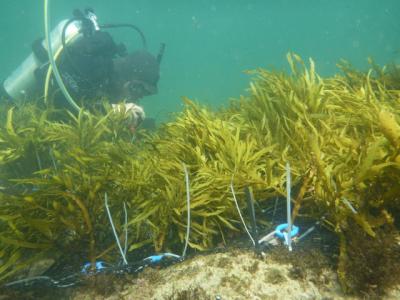
Researcher tying P. comosa plants to the sea floor.

Giant seaweeds like P. comosa attach to the sea floor with their aptly named holdfasts. They don’t have a root system that you can bury in soil like you would if you were planting a tree. Therefore, to reestablish the P. comosa colony, the plants had to be tied to mesh matts with cable ties. In order to determine whether that procedure itself was overly traumatic, some of the plants were removed and then tied down in their original habitats. Other plants were left completely undisturbed.

Survival of algae that were translocated to Sydney was about 70%. This is about the same survival rate as that of totally undisturbed plants, suggesting that moving P. comosa to a new habitat is not harmful. Even more promising, the transplanted algae were able to successfully reproduce at their new site.

It is possible to clean a marine environment so that it’s once again suitable for its original inhabitants. The question is only whether we have the will to do so.


Campbell AH, Marzinelli EM, Vergés A, Coleman MA, & Steinberg PD (2014). Towards restoration of missing underwater forests. PloS one, 9 (1) PMID: 24416198.


Monday, February 3, 2014

Who has the largest genome?

When you think of the largest genomes in the animal kingdom, what comes to mind? Humans? Not even close. Some other type of mammal? Nope. At least it must be a vertebrate, right? Sorry. The largest genome found to date belongs to Locusta migratoria, aka the locust.

A team of dozens of scientists from the Chinese Academy of Sciences and other institutions have managed to sequence the locust’s genome, which weighs in at a whopping 6.5 gigabytes. To put that in perspective, the human genome, with which we’ve managed to be fairly successful, contains a little less than half as much DNA. Why on Earth does a lowly insect need that much DNA?

Many of the genes discovered by the authors may be required for the insects’ Jekyll to Hyde transformation from relatively benign grasshoppers into swarming locusts. As grasshoppers, the insects live solitary lives close to home. However, when their numbers reach a certain threshold where they start bumping into one another, they transmogrify into ravenous swarms that travel up to 100 miles per day. Locusts need whole classes of genes to cope with the energy requirements for long distance flight and to allow them to digest everything they encounter.

However, the main reason that the locust genome is so enormous is that it contains a massive number of repetitive elements. These are fragments of DNA that, due to a replication error, have become duplicated over and over again. This kind of thing can happen in any genome, but locusts seems to be particularly lazy about trimming away the excess DNA.


Wang X, Fang X, Yang P, Jiang X, Jiang F, Zhao D, Li B, Cui F, Wei J, Ma C, Wang Y, He J, Luo Y, Wang Z, Guo X, Guo W, Wang X, Zhang Y, Yang M, Hao S, Chen B, Ma Z, Yu D, Xiong Z, Zhu Y, Fan D, Han L, Wang B, Chen Y, Wang J, Yang L, Zhao W, Feng Y, Chen G, Lian J, Li Q, Huang Z, Yao X, Lv N, Zhang G, Li Y, Wang J, Wang J, Zhu B, & Kang L (2014). The locust genome provides insight into swarm formation and long-distance flight. Nature communications, 5 PMID: 24423660.